




Dalberg uses cookies and related technologies to improve the way the site functions. A cookie is a text file that is stored on your device. We use these text files for functionality such as to analyze our traffic or to personalize content. You can easily control how we use cookies on your device by adjusting the settings below, and you may also change those settings at any time by visiting our privacy policy page.
Across the EU, US, and UK alone, more than 54 million people work along food supply chains. At the same time, food production, particularly high-emission animal agriculture, remains a major driver of greenhouse gas emissions. Research shows that shifting toward more sustainable diets, such as the EAT-Lancet Planetary Health Diet, could reduce global food-related emissions by up to 49% by 2050. Dietary change is therefore essential to achieving net-zero goals.
However, transforming what we eat will fundamentally reshape who works and how in the food system. Reductions in red meat, dairy, and poultry consumption could result in long-term job losses in livestock-related sectors, while plant-based value chains such as legumes, fruit, vegetables, and alternative proteins are projected to expand significantly.
These impacts will not always take place in the same regions, meaning that a meatworker in Germany will face different impacts from a tomato farmer in Spain. Without deliberate planning, the transition to a sustainable food system risks deepening inequality and destabilizing communities dependent on high-emission sectors. If managed well, though, it creates an opportunity to build a more resilient, healthier, and sustainable food system that puts workers at the center.
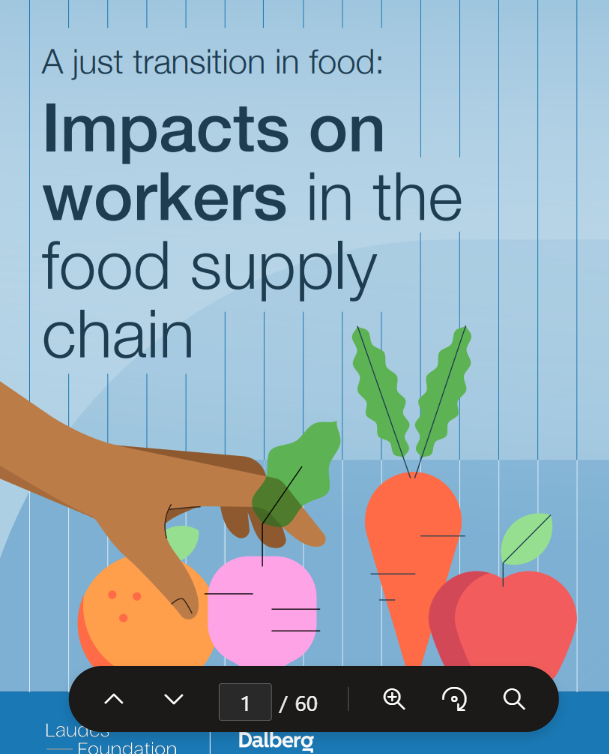
The new report “Just Transition in Food: Impacts on Workers in the Food Supply Chain,” developed by Dalberg Advisors and commissioned by Laudes Foundation, outlines the scale and distribution of projected impacts on workers and identifies priority actions for policymakers, businesses, and investors, including reskilling, social protection, regional diversification, and proactive workforce planning.
Read the full report to learn more.