

Dalberg uses cookies and related technologies to improve the way the site functions. A cookie is a text file that is stored on your device. We use these text files for functionality such as to analyze our traffic or to personalize content. You can easily control how we use cookies on your device by adjusting the settings below, and you may also change those settings at any time by visiting our privacy policy page.
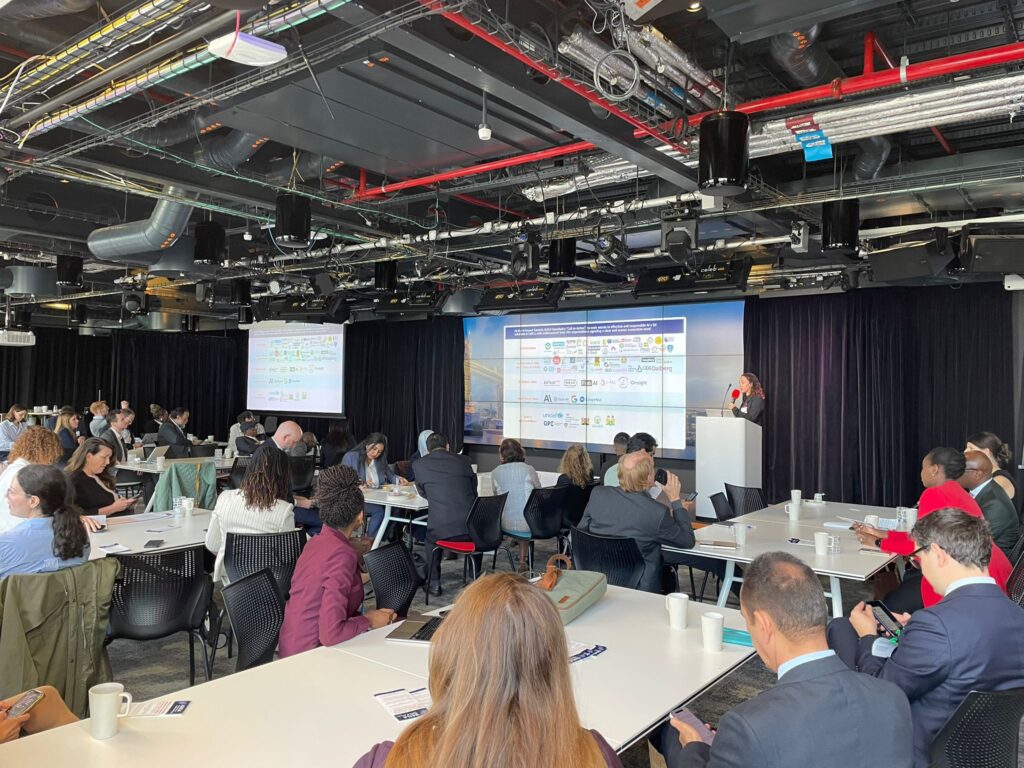
AI for learning will only deliver on its promise if governments set the agenda from the start. This conviction shaped the Global AI for Learning Alliance (GAILA) co-creation workshop held in London in May at the Google offices on the sidelines of the Education World Forum. Co-hosted by UNICEF and Fab AI, the workshop brought together over 70 government and ecosystem leaders, including education ministers and senior officials including from Sierra Leone, Rwanda, Iraq, and Brazil. The focus was co-shaping the Global AI for Learning Industry Compact, a framework designed to translate growing momentum in AI in education into coordinated, practical action.
Starting with evidence
The workshop followed a discussion of Sierra Leone’s experience with AI for learning, a deliberate choice to ground a forward-looking conversation in implementation reality. Sierra Leone’s journey showed what responsible adoption can look like when evidence, government leadership, and context-sensitive design come together. It gave the sessions a concrete reference point and a useful benchmark for the work ahead.
What the conversations surfaced
Three themes emerged consistently across the sessions:
Government leadership is not optional: AI tools are most likely to serve education systems well when education system leaders are involved in shaping them, not simply receiving them. A power imbalance persists in how tools are designed, procured, and adopted, and closing that gap starts with governments engaging earlier and with greater authority. As Benjamin Piper put it: “We need to think about the public goods the entire sector requires, such as standards, benchmarks, and language tools, and not just individual products.”
Technology without implementation support rarely lands: Solutions that do not reflect classroom realities, or that add to, rather than reduce, teacher burden, tend to stall regardless of their technical quality. Teacher training, digital literacy, and wider implementation infrastructure are not optional; they are what make adoption real.
Shared investment in public goods is what makes the difference at scale: Datasets, common standards, and rigorous evidence are not the responsibility of any single actor. The Sierra Leone study is a strong model for the kind of evidence the sector needs; it examines what was achieved, under what conditions, at what cost, and how quality holds as interventions scale. More such studies across more contexts will make good decisions possible.
Minister Conrad Sackey of Sierra Leone captured the spirit of the Compact well: “The Global AI for Learning Alliance gives me hope: a neutral platform where AI companies and the global education community can make real mutual commitments with accountability, not just pledges or press releases.”
That orientation toward accountability, building structures that hold over time, was echoed by Dr. Wongani Grace Nkhoma Sankofa of UNICEF: “Global frameworks must help generate evidence globally and contextually on what works, and most importantly, what works for whom, not for edtech or AI companies, but for the children and communities we serve.”
Beyond the GAILA co-creation workshop, Dalberg Partner and Education to Employment Practice Co-Lead Dayoung Lee, representing the GAILA Secretariat, also spoke alongside Benjamin Piper from the Gates Foundation at the Global Partnership Conference technology plenary, where GAILA was highlighted as a “Trailblazing Innovation Partnership,” an example of the kind of multi-stakeholder coordination the sector is increasingly calling for.
Watch this clip from the plenary where Dayoung and Benjamin discuss what responsible, collaborative AI for learning requires:
Looking ahead
The London workshop was one moment in a longer co-creation process. GAILA’s work on the Compact continues in the months ahead, with UNGA, this September, as a key milestone.
We are grateful to Minister Conrad Sackey, Minister Claudette Irere, Benjamin Piper, Dr. Wongani Grace Nkhoma Sankofa, Carlos Ferrari, Lea Simpson, Paul Atherton, and Mathias Esmann for their leadership and participation.