

Dalberg uses cookies and related technologies to improve the way the site functions. A cookie is a text file that is stored on your device. We use these text files for functionality such as to analyze our traffic or to personalize content. You can easily control how we use cookies on your device by adjusting the settings below, and you may also change those settings at any time by visiting our privacy policy page.
As the Fund for Responding to Loss and Damage (FRLD) Board meets in Zambia, new analysis highlights urgent need to mobilize financing and strengthen education systems to address climate-related loss and damage and protect children’s learning.
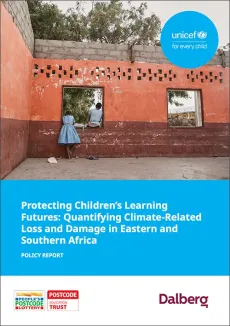
NAIROBI, 20 April 2026 – Climate-related disasters have already cost education systems in Eastern and Southern Africa USD 1.3 billion in direct loss and damage to schools and teaching infrastructure, and disrupted learning for 130 million children, according to a new UNICEF and Dalberg report, Protecting Children’s Learning Futures: Quantifying Climate-Related Loss and Damage in Eastern and Southern Africa. The analysis estimates these disruptions have resulted in up to USD 140 billion in lost future earnings, which could rise to USD 380 billion by 2050 as climate impacts intensify and affect up to 520 million students.
“Children are paying the highest price for a crisis they did not create,” said Etleva Kadilli, UNICEF Regional Director for Eastern and Southern Africa. “For the first time, this report shows the scale of climate-related loss and damage to education, yet the impact on children remains largely invisible in financing decisions. This must change.”
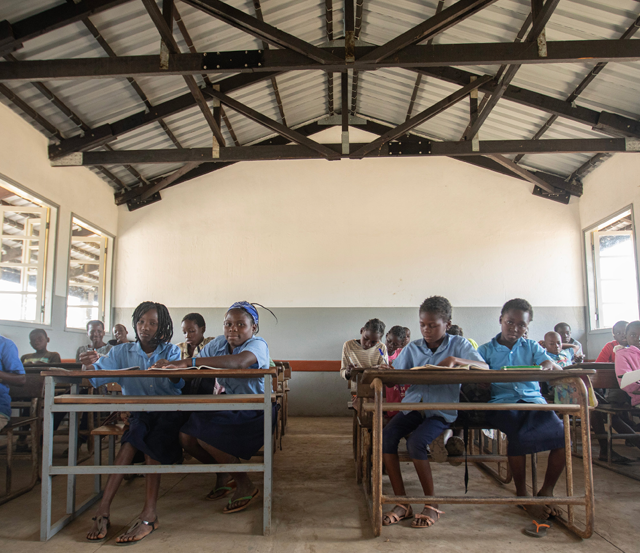
The UNICEF and Dalberg report includes in-depth analysis from Ethiopia, Kenya, Mozambique, Somalia and Zambia, demonstrating how increasing and more intense extreme weather events—including floods, droughts, cyclones and heatwaves—are destroying school infrastructure, forcing children out of classrooms, and disproportionately affecting girls, children with disabilities, and marginalized communities.
Zambia’s experience illustrates the scale and human toll. Between 2005 and 2024, floods and droughts disrupted learning for 5 million students and caused USD 60 million in immediate education infrastructure losses, while reducing future earnings by up to USD 5 billion. The severe 2023–2024 El Niño drought in Southern Africa, one of the worst in decades, left nearly 10 million people without food, water, or power, forcing schools to reduce hours, close temporarily, or send students home early. Rural children and girls were disproportionately affected, with many dropping out to support family livelihoods or facing increased child marriage risks.
Despite these impacts, education receives less than 1.5% of global climate finance, leaving education systems exposed to repeated cycles of loss and recovery. The UNICEF and Dalberg analysis shows that strengthening schools to withstand climate shocks not only protects education but delivers strong economic returns, with every USD 1 invested generating up to USD 13 in benefits by reducing damage and interruptions, safeguarding learning continuity, and preserving children’s long-term development and productivity.
“Without stronger prioritization in climate finance, education will continue to bear the brunt of climate impacts, driving repeated disruption,” continued Ms Kadilli. “We must design education systems that anticipate shocks, protect early and foundational learning, and keep schools open. Otherwise, the true cost of climate loss and damage will be measured in lost human potential.”
As the FRLD Board meets in Livingstone later this week, recognizing children not only as those most affected, but as rights-holders with needs, capacities and voices that must shape recovery and resilience, is essential. To protect children’s futures and further advance Africa’s long-term development, UNICEF urges governments, donors, and climate funds to:
1. Strengthen the integration of education within national climate frameworks: Explicitly reference education in National Adaptation Plans (NAPs) and Nationally Determined Contributions (NDCs), to help unlock access to climate and loss-and-damage financing.
2. Apply a climate-risk lens to domestic education financing: Ensure budget allocations to education are climate-informed, prioritizing the critical, foundational stage of learning for children and continuity of education in the face of climate shocks.
3. Scale and target international climate finance for education: Ensure major climate funds, including the Green Climate Fund, Adaptation Fund and the Fund for Responding to Loss and Damage (FRLD), allocate dedicated resources to education, with FRLD specifically supporting unavoidable losses when climate impacts exceed what education systems can adapt to.
Country analyses in the UNICEF and Dalberg report includes:
– Kenya: 2024 floods disrupted schooling and widened gender gaps in re-enrollment, particularly for girls and children with disabilities.
– Somalia: Repeated droughts, floods and conflict have driven mass displacement, leaving millions of children out of school and newly displaced children—especially girls—least likely to attend.
– Mozambique: Cyclones Idai and Kenneth in 2019 showed that while thousands of classrooms were destroyed, those built to resilient standards withstood the impact—highlighting both the returns on investment and the scale of unmet need.
– Ethiopia: Rising temperatures and more frequent heatwaves affect 83% of children, and are already disrupting school attendance, reducing concentration in the classroom, and undermining learning outcomes.
For media enquiries:
UNICEF Nairobi
Alicia Jones +254724322162 | aljones@unicef.org
Dalberg Advisors
Jacqui Hocking +65 84545945 | Jacqui.hocking@dalberg.com
Pronoti Datta +91 9821932723 | Pronoti.datta@dalberg.com
About UNICEF
UNICEF, the United Nations agency for children, works to protect the rights of every child, everywhere, especially the most disadvantaged children and in the toughest places to reach. Across more than 190 countries and territories, we do whatever it takes to help children survive, thrive, and fulfil their potential.
About Dalberg Advisors
Dalberg Advisors is a global professional services firm that puts impact at the center of decision-making. Founded in 2001, Dalberg Advisors now has over 430 full-time staff spread across 27 locations, bringing global perspectives to local solutions for over 1200 clients. This includes local and international NGOs, governments, financial institutions, philanthropies and business leaders, and entities that sit at the intersections of these organizations.