


Dalberg uses cookies and related technologies to improve the way the site functions. A cookie is a text file that is stored on your device. We use these text files for functionality such as to analyze our traffic or to personalize content. You can easily control how we use cookies on your device by adjusting the settings below, and you may also change those settings at any time by visiting our privacy policy page.
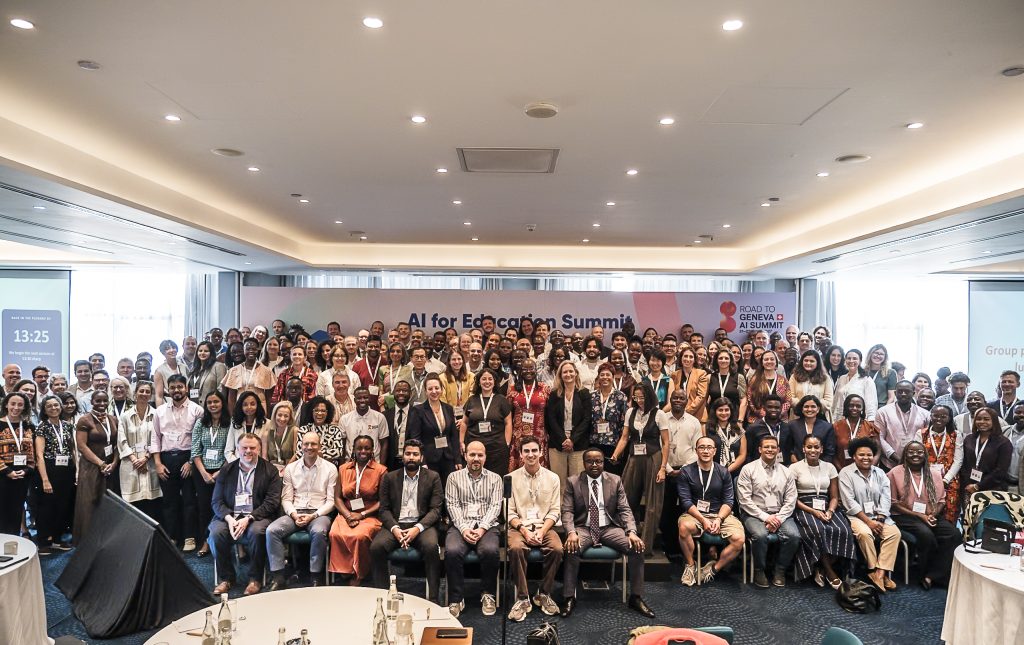
Reflections from the AI for Education Summit on translating child safety standards into practice.
We are investing in making AI more capable, more affordable, and more accessible to learners around the world. Are we investing equally in making it safe? That was one of the central discussions at the recent AI for Education Summit in Nairobi, hosted by the Gates Foundation and the Quality Assurance Facility for AI in Education.
Child safety matters to policymakers, parents, and educators, and global principles and standards are well developed. Yet the infrastructure to make AI safe across languages, cultures, and education systems is not keeping pace with the technology.
At the Summit, the Global AI for Learning Alliance (GAILA) and Quality Assurance Facility convened a discussion with inputs from UNESCO, UNICEF, Oak National Academy, Digital Promise, i.AI and others. We focused on two questions:
- How do we contextualize global child safety standards for different countries, languages, and educational settings without weakening fundamental protections?
- How do we move from standards on paper to adoption by governments, developers, and educators?
Four insights emerged:
1. Applying existing standards across contexts is the hard part.
UNESCO’s AI guidance and UNICEF’s EdTech for Good framework set out global principles. Other groups are turning them into practice. Oak National Academy, for example, built safeguards for its AI lesson planning assistant that sorts content into four tiers: safe, sensitive and needing teacher guidance, too sensitive for AI-generated lessons, and blocked.
How much of this work can be reused across countries, and what requires local adaptation?
Some protections, including children’s rights, privacy, and non-discrimination, must stay universal. Others need local judgment. An AI tutor in India has to discuss caste without reinforcing discrimination. Participants explored scenario-based testing, where local experts evaluate AI responses to realistic situations, as one approach.
Language is a harder problem still. Models that recognize harmful content in English can miss it in lower-resource languages. Fixing that takes locally relevant data, expert review, and testing in each language.
Local data governance issues complicate this further. In Tanzania, restrictions on processing children’s voice data outside the country make model development harder, even though the protections serve an important purpose.
Without investment in local language data, safety evaluations, and clear local regulation, children in lower-resource settings risk weaker protections, a two-tier system. This work is expensive, and few individual developers have the resources or incentives to do it alone.
2. Safety comes in degrees. Acceptable risk and accountability take human judgment.
What does it mean for an AI system to be safe enough for classroom use? Take an AI reading assessment that can tell whether a child can read but misses an underlying learning disability. It makes assessment faster while producing an incomplete or misleading picture of the learner.
Should AI meet the same standard as teachers, or a higher one? Is a 90% success rate sufficient? It depends on the application, the consequences of failure, and the safeguards available. Technical evaluations measure performance. They cannot decide which risks are acceptable.
Who decides matters too. Governments set requirements, developers build and test products, and educators oversee classroom use. Accountability is often fragmented, including across government ministries. When governments don’t set clear requirements, the decision falls to schools, teachers, and families, who have fewer resources to evaluate risk. Inaction is itself a decision, and probably a risky one.
We need minimum protections now, with processes to update them as evidence and technology change.
3. Adoption depends on trust, capacity, and incentives.
Participants named three barriers.
- Trust. Governments and educators need more transparency about how products are tested, what they do well, and where risks remain.
- Capacity. Ministries face constrained budgets, competing priorities, and limited technical expertise. Governments and smaller developers need hands-on implementation support and clear guidance.
- Uncertainty. Immediate harms are easier to test than the long-term effects of AI on children’s learning, independence, and wellbeing.
Participants also said users have to help define safety.
UNICEF consulted teachers while developing an AI-enabled support tool. Beyond lesson planning and assessment, teachers raised an unexpected concern: could the tool be used for government surveillance of their performance? Digital Promise shared that students testing an AI mathematics tool complained it gave too much help. They wanted to solve the problems themselves.
Both examples show that safety covers more than blocking harmful content. It includes protecting agency, trust, and learning.
Governments can shift incentives through procurement and regulation by requiring developers to prioritize safety from the start. Requirements have to be practical and proportionate, or they will shut out smaller developers and constrain locally relevant innovation.
4. Collective action can make safety achievable at scale.
The goal is to make existing protections easier to implement. Participants suggested five areas for collaboration.
- Practical tools and support. Turn standards into procurement checklists, implementation guidance, and technical assistance for governments and developers.
- Shared safety infrastructure. Build on existing benchmarks, datasets, and safeguards, such as Oak National Academy’s work, so no one starts from scratch.
- Regional collaboration. Pool resources for locally relevant evaluation, especially across countries that share languages or educational contexts.
- Testing and incentives. Set up shared testing sandboxes and innovation competitions.
- Continuous improvement. Share lessons from real deployments and update safeguards as technology and evidence change.
These are public goods that benefit the whole ecosystem but may not be commercially attractive for any single organization to fund. They are also the most expensive part. Evaluating AI in lower-resource languages, securing appropriate child data, and building local technical capacity all need sustained investment. m the outset.
A call for collective action
The AI education ecosystem has shown what is possible when funders, governments, developers, and educators invest together in innovation. Child safety needs the same commitment.
GAILA is working to move child safety from principles to practice by connecting existing efforts, identifying shared gaps, and advancing approaches that governments and developers can adapt and adopt.
We invite governments, researchers, developers, funders, and other partners to work with us on making child safety standards actionable, particularly in low- and middle-income countries.