

Dalberg uses cookies and related technologies to improve the way the site functions. A cookie is a text file that is stored on your device. We use these text files for functionality such as to analyze our traffic or to personalize content. You can easily control how we use cookies on your device by adjusting the settings below, and you may also change those settings at any time by visiting our privacy policy page.

How can we ensure that consumers, workers, and traditional communities can benefit from and be an integral part of the just transition in food systems, and create a system that creates economic opportunities for all? It’s a tall order, but we have no choice but to get it right.”
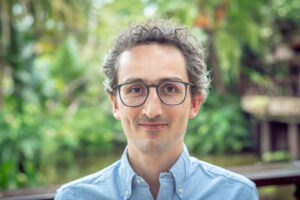
Alexandre Cheval is a Partner at Dalberg Advisors, based in Singapore, and works across renewable energy, climate and Environment, and food systems in Southeast Asia.
In this conversation, he reflects on the financing gaps slowing climate and food systems transitions, the role of philanthropy and catalytic capital in unlocking scale, and what it will take to build more resilient land-use systems.
1. You have designed financing and governance prototypes to accelerate regenerative agriculture and agroecology in Kenya and Tanzania. What did those pilots reveal about why capital is not flowing at scale?
There are multiple challenges at play. First, agreeing on what we mean by regenerative agriculture and agroecology isn’t easy. It varies by landscape, which makes it difficult to apply a one size fits all approach. Second, the sheer magnitude of the need creates a risk of dilution of efforts with different funders supporting worthy causes but without always coordinating closely, or in different landscapes. This is why we have been advocating for lighthouse landscape approaches that bring together government, philanthropy and private capital to demonstrate how joining hands can accelerate the shift to sustainable agriculture. The idea is to then replicate this approach in other landscapes. We’ve also identified a long list of investable opportunities and of deal-specific collaboration where a funders and grant-makers can work alongside early stage and commercial investors to accelerate the transition; so we’re hoping to see a lot more funding flowing soon!
2. In your recent work assessing catalytic capital opportunities across Asia Pacific, where did you see the strongest pipeline for mitigation and adaptation solutions?
The climate adaptation financing gap (the difference between how much we should be investing and how much we are actually investing in) in Southeast Asia is estimated at USD 180+ billion per year. That is staggering. The good news from our recent work, which is the first anyone has looked comprehensively at the specific, existing adaptation solutions in Southeast Asia, is that many solutions exist for every investor out there. There are plenty of public goods that require further funding because public funding just can’t keep up with the need to upgrade health facilities or climate-proof critical infrastructure across the region. There’s also plenty of viable solutions that are already commercial, but not deployed at scale in Southeast Asia, like sensor-based irrigation or AI-enabled prediction systems. And finally, there’s a massive opportunity for catalytic capital, from de-risking nascent business models like passive cooling wearables or parametric insurance to enabling financing at scale for solutions with proven, low-risk and low return, such as solar powered cold storage infrastructure for food and health facilities in remote areas.
3. When it comes to supporting sustainable land use in major forest basins, given the political complexity and competing economic interests, where can philanthropy realistically move the needle?
We recently published a full article on this which I highly recommend, but broadly we’re seeing three primary roles philanthropy can support when it comes to land use. First, catalytic capital can encourage more investments into specific businesses by seeding or de-risking innovative business models that have yet to prove their commercial viability, like novel approaches to resilient seed breeding or agroforestry and intercropping models. Second, it can encourage the development of collectively owned transition roadmaps that identify priority interventions and enable coordination around specific solutions across multiple implementers, financiers, etc. Third, philanthropy can bridge the gap between supply and demand, helping connect large demand pools for example from school meals, direct-to-consumer models or sustainability-certified buyers with small businesses, farmer cooperatives, or farmers, while providing them the financing, certification and technical support that will help them meet these needs.
4. Dalberg completes 25 years this year. You have stepped into Partnership at a moment when the climate and food systems agenda is more urgent and complex than ever. What do you think Dalberg must continue to do or do differently in the next decade to stay credible and impactful in agriculture and land use?
Food systems are a crucial lever to address climate: it accounts for 1/3 of emissions. Conversely, climate change will massively impact food production across the global, from droughts to flooding, to long-term yield dips as soils get further degraded. In this context, we’ve been thinking a lot about what a just transition means in the context of food systems. A lot of my work has been focused both in advanced and emerging economies on how we can ensure consumers, workers, traditional communities can benefit, be an integral part of the transition, and to create a system that creates economic opportunities for all. It’s a tall order, but we have no choice but to get it right.