

Dalberg uses cookies and related technologies to improve the way the site functions. A cookie is a text file that is stored on your device. We use these text files for functionality such as to analyze our traffic or to personalize content. You can easily control how we use cookies on your device by adjusting the settings below, and you may also change those settings at any time by visiting our privacy policy page.
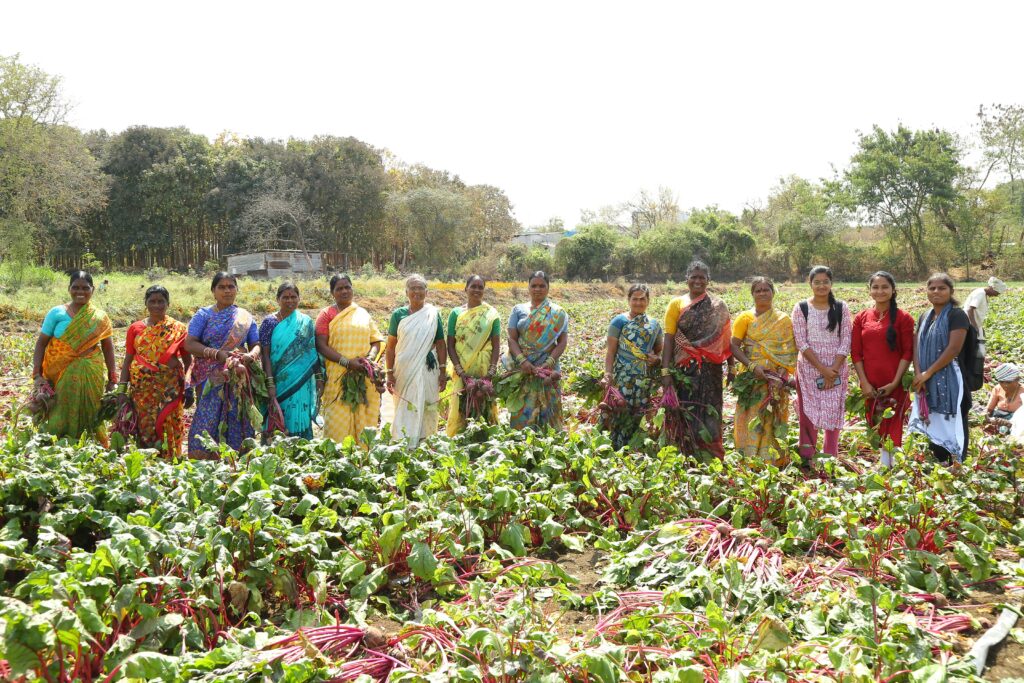
India stands at a rare economic moment. Women’s economic empowerment is increasingly positioned as a national growth strategy, and rightly so. The upside is enormous. If India reaches 70% female labor-force participation by 2047, women could contribute 40-45% of the country’s USD 30 trillion GDP ambition, more than agriculture and manufacturing combined.1
India already has the foundational policy architecture to match this ambition. Nearly 10% of the Union Budget, INR 4.7 lakh crore,2 is allocated as gender-responsive expenditure across nine ministries. The National Rural Livelihoods Mission (NRLM) has mobilized 10 crore rural women3 into self-help groups and unlocked INR 11 lakh crore in credit.4 Direct Benefit Transfer (DBT) programs deliver INR 1.7 lakh crore5 directly to women. Women now make up 46% of village council representatives6. The access and participation levers are in place.
But this has not reliably translated into productivity or power. Women-led rural enterprises remain largely subsistence businesses. Women hired into formal jobs are concentrated in low-value sectors or low-productivity roles. Cash transfers can ease constraints, but do not automatically create sustained economic opportunity or agency.
India’s next challenge is to shift outcomes towards productivity and power across seven areas
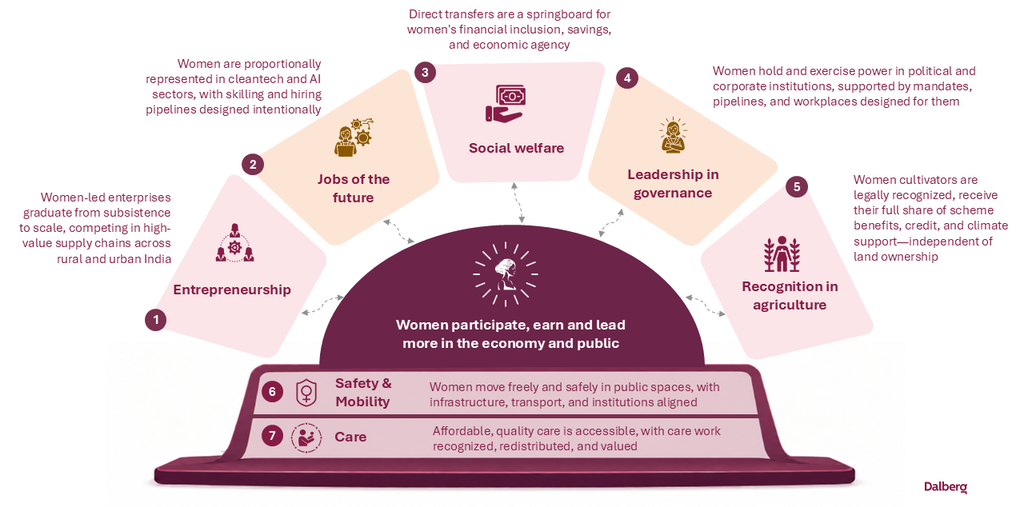
There is already substantial activity across this agenda. Government investment alone is approximately INR 1.5 lakh crore7 across these areas, complemented by philanthropy, multilaterals and CSR. This means policy intent, delivery machinery and promising models are already in place. They also have clear leverage points, i.e., known constraints, which if unlocked, compound progress.
More than additional schemes, the need is to make existing investments work harder and converge. Five principles are important in this shift.
1. Converge schemes around women’s economic journeys
India has many of the necessary schemes, institutions and delivery mechanisms. The challenge is that they often operate in parallel: finance may sit separately from market access; skilling from scholarships and apprenticeship programs; DBT from financial inclusion initiatives. For women whose barriers are interconnected, accessing one input rarely resolves the full set of constraints that limits their ability to pursue livelihood opportunities.
Entrepreneurship illustrates the gap. NRLM has done the hard work of mobilizing rural women into organized groups and expanding access to credit. But credit alone cannot overcome weak demand, fragmented distribution and limited access to higher-value markets. Women entrepreneurs need finance, enterprise capability, buyers, aggregation, logistics and sector-specific support to work together as one system.
There is already momentum in this direction. The Rural Prosperity and Resilience Programme (RPRP) is bringing together 14 departments and 38 schemes8 around resilient rural prosperity—aligning financing, market access and capacity-building for women entrepreneurs. The real test will be making this convergence work at district and village levels, while bringing in private buyers, industry partners, finance providers and philanthropy.
2. Scale demand-led pathways and industry-linked models
Women need more than access to training, credit or entrepreneurship support; they need pathways into opportunities with clear and sustained market demand. Too often, public programs focus on supply-side inputs—skills, finance or collective formation— without sufficient connection to the employers, buyers, value chains and growth sectors that determine whether those inputs translate into income.
In jobs, this means moving beyond skilling towards sustained careers. Industry should help shape curricula and standards, offer apprenticeships and pathways into employment, and work with public systems to support retention. The ultimate goal is women’s progression into productive, higher-value work.
3. Pair economic interventions with the foundations that enable participation
Women’s economic participation is shaped as much by the conditions around work as by the work opportunity itself. Even when jobs, training or enterprise support are available, women may be unable to use them because care responsibilities, safety concerns, limited mobility and restrictive norms constrain their time, movement and decision-making.
This is not to suggest that foundational work on care, safety, mobility and norms is absent. But these interventions and livelihood programs are rarely designed with each other in mind. For instance, urban care investments are rarely designed around where women actually work. Urban childcare is a case in point: policy has focused on employer-provided facilities and Aanganwadi-cum-crèches under the Palna Scheme,9 but these models do not adequately reflect where women work. More than 90% of women work in MSMEs,10 where childcare close to the workplace is largely unavailable. Care infrastructure needs to be developed in sync with livelihood opportunities.
4. Shape economic transitions before they widen inequality
Climate change and AI are reshaping the sectors in which large numbers of women work. Women make up 53% of jobs11 in sectors affected by climate change, including agriculture, textiles and fisheries. Yet without targeted investment, they are projected to account for only around one in ten jobs created in emerging clean-tech sectors by 2030. The pattern is similar for AI: women hold up to one-third of jobs12 in sectors being disrupted or transformed by AI but could occupy only around one-fifth of AI-created jobs by 2030.
This requires a broader approach that anticipates disruption and builds pathways into emerging clean-tech and AI-enabled roles. While much of this work is beginning broadly, policies must be gender-responsive from the outset—recognizing that stereotypes of STEM as a “male domain”, limited mentoring and networks, and the high cost of training compound broader system-level barriers in these sectors.
5. Build data systems that go beyond measuring female labor force participation alone
This ambition cannot be tracked just through female labor-force participation. Participation is an important measure, but it does not tell us whether women are earning more, moving into higher-productivity work, building viable enterprises, gaining control over resources or exercising greater voice and agency.
This agenda needs nationally comparable, high-quality data that captures outcomes across participation, earnings and income, enterprise and career progression and asset ownership. It must also allow comparison across states, sectors and groups of women, so policies and programming can be more specific.
Many organizations, individuals and government institutions are already advancing parts of this agenda. Over the coming months, we will explore in greater depth what these shifts mean across the outcome areas laid out above, with some of these organizations and individuals.
This article is the first instalment of a thought leadership series around Bharatiya Nari Shakti Platform, a proposed high-level, multi-stakeholder platform dedicated to coordinating action on women’s economic empowerment.
Notes
- Dalberg Analysis; estimates are directionally aligned with findings from the Magic Bus and Bain & Company report titled ‘Building India’s 400 million women workforce‘; contributions of manufacturing and agriculture taken from NITI Aayog, From Borrowers to Builders , 2025 and PIB, Press Release, 2025, PIB, Press Release, 2024. ↩︎
- Government of India, Expenditure Profile, 2026-27; share of various ministries and departments of the total gender budget 2026-27. ↩︎
- Ministry of Rural Development, Department of Rural Development: Year Ender Report, 2025. ↩︎
- Ministry of Rural Development, Department of Rural Development: Year Ender Report, 2025. ↩︎
- PRS, State of State Finances, 2025; respective scheme websites and State Budget Documents of all states. ↩︎
- Ministry of Panchayati Raj, ‘Elected Women Representatives of Panchayati Raj Institutions to Participate in CPD57 Side Event “Localizing the SDGs: Women in Local Governance in India Lead the Way” on 3rd May 2024 at United Nations Headquarters in New York‘, 2024. ↩︎
- Dalberg analysis on Government of India, Expenditure Profile, 2026-27; Gender Budget has 3 parts–for this estimation only Part A and B are considered as only those are women-specific or pro-women schemes with Part A having 100% women specific schemes and Part B having 30-99% women beneficiaries. ↩︎
- Rural Prosperity & Resilience Program (RPRP); National Rural Livelihood Mission. ↩︎
- Palna Scheme. ↩︎
- Ministry of MSME, Annual Report 2024; Chen et al, Urban Employment in India: Recent Trends and Patterns, 2014. ↩︎
- Dalberg analysis of share of women in sectors being disrupted or transformed by climate change. ↩︎
- Dalberg analysis of share of women in sectors being disrupted or transformed by AI. ↩︎

SHRUTI GOYAL
Partner, Dalberg Advisors