
Dalberg uses cookies and related technologies to improve the way the site functions. A cookie is a text file that is stored on your device. We use these text files for functionality such as to analyze our traffic or to personalize content. You can easily control how we use cookies on your device by adjusting the settings below, and you may also change those settings at any time by visiting our privacy policy page.
For over two decades, the global health sector has relied on donor funding to develop, launch and scale new global health products. Donors funded the research behind new products, paid to introduce them (often via intermediaries that acted as a commercial ‘quarterback’ of sorts), then acted as a ‘buyer’ for these products to help sustain them at scale. Annual neglected disease R&D funding, which includes HIV, TB and malaria, peaked at more than USD 4.8 billion in 2018. Two funders alone, the Global Fund and Gavi, spend over USD 2.5 billion a year on health products and about USD 3 billion a year on immunization programs. This model no longer holds.
As official development assistance (ODA) contracts and funding priorities shift, funding for new health products is diminishing, leaving a significant gap in financing and procurement for global health products. ODA is projected to fall 40-60% over the next five years1, driven by tightening national budgets and shifting geopolitical priorities. HIV, tuberculosis, malaria and maternal health are most exposed: each draws more than 70% of its financing from ODA, and over 30% from US government sources alone. The pattern is not confined to one donor. US aid froze first: within weeks, USAID’s largest global health program (GHSC-PSM) was cut, having spent USD 13 billion over 20 years. European donors are tightening their spending along similar timelines. The direction of travel is the same across the donor base: less money, committed for shorter periods, with less certainty it survives the next budget cycle. The cuts reach both ends of the chain. Neglected disease R&D had already slipped from about USD 4.8 billion in 2018 to USD 3.75 billion in 2024, and estimates predict that US government global health R&D funding fell by about USD 730 million, just over 15%, in 2025. On procurement, Gavi cut annual disbursements by 15% (USD 447 million) between 2025 and 2026, and UN agencies by 18% (USD 873 million).
Many now look to African governments to fill this gap, but they cannot do it alone. Government sources fund only 35% of health spending across Africa, and debt service is eating into what room they would otherwise have. As a result, the sector is having to ask: what new models will allow us to most effectively and efficiently launch and scale new global health products moving forward? The older launch and scale models often relied on significant donor subsidy to introduce products rather than relying on market forces, funded organizations in the Global North rather than hyper-local organizations, and did not build in sustainability requirements from day one. In this new era, new models are being built and tested that could unlock more effective and efficient success.
Five launch and scale models, one spectrum
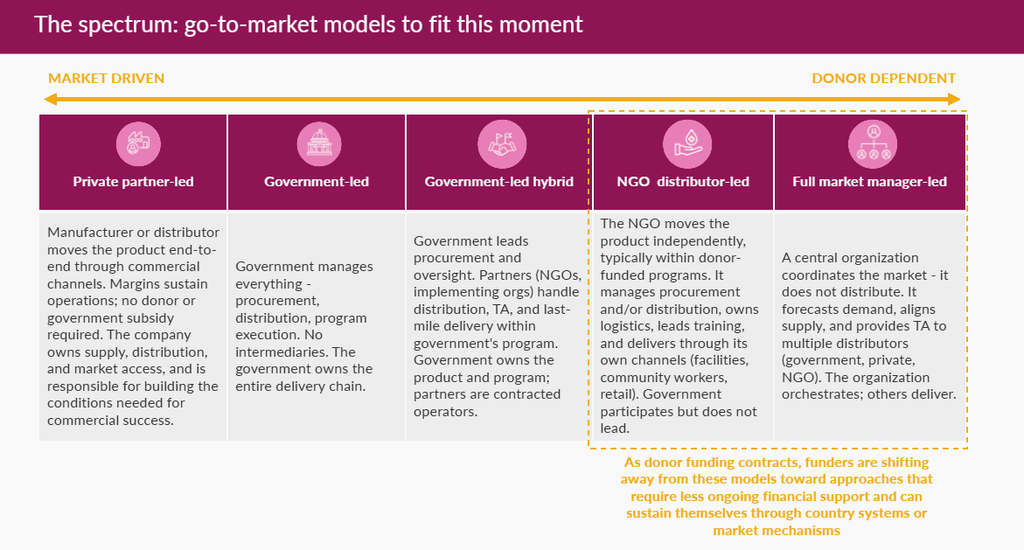
In practice, health products reach the market through one of five approaches, and where a product sits on the spectrum below shapes how exposed it is to the current funding crunch.
The spectrum measures dependence on donors. On the left, commercial players or government budgets pay for the product. On the right, donors must fund and coordinate it year after year. Two things move a product along it: how much demand already exists, and how the product’s price and margin compare with what it replaces. Where demand is clear and margins hold, a product can sit at the left. Where a market must be created, or margins are thin, it slides right.
A handful of real programs show how differently this plays out depending on where a product sits on the spectrum
- Malaria treatments are private partner-led, but a subsidy kept their price low. Private distributors sell a WHO-approved ACT (artemisinin combination therapy) through drug shops and pharmacies. From 2010 the Global Fund paid part of its cost, cutting the shop price by as much as tenfold. Nigeria ended the subsidy in 2018. By 2021 the drug cost 42% more than in 2016, and the share of surveyed outlets stocking it had fallen from 72% to 15%. Cheaper rival ACTs filled the gap, so people still bought an effective treatment. In this model the shelf picks the winner, and an advantage built on a subsidy ends with it.
- South Africa’s ART regimen is government-led. The state procures and distributes it entirely through its own budget and tendering process, making it the world’s largest procurer of antiretrovirals.
- The malaria vaccine is government-led hybrid. Gavi and UNICEF fund and buy the vaccine centrally; governments deliver it through their own immunization programs.
- The contraceptive implant began as an NGO-led market and has since moved towards government delivery. Marie Stopes International (now MSI Reproductive Choices) led the early scale-up through its own mobile outreach teams and clinics, raising implant provision almost ninefold between 2008 and 2012 in 15 sub-Saharan African countries. As supply and prices improved and governments committed to implants, the public sector became a major provider, holding 60% of implant protection in Ethiopia and 53% in Nigeria. MSI now pairs its outreach teams with government providers in several countries.
- DMPA-SC is full market manager-led. PATH leads the Injectables Access Collaborative, providing technical assistance, coordination, and market analysis for donors, governments, and manufacturers, while governments and private providers handle actual delivery.
The shift underway now runs leftward along this spectrum toward models that sustain themselves through commercial markets or government systems, and away from ones that depend on donors staying coordinated and funded year after year.
Matching the model to the product
Each model on the spectrum works only if specific conditions hold. Two conditions recur: how much demand already exists, and whether price and margin beat the current comparator. Existing demand makes the private and government routes easier. If a market must be created, then products need to be pushed by donor-backed models. Private, partner-led models need existing demand and enough margin and volume to justify commercial distribution without subsidy. Government-led needs a clear demand, a price the budget can bear and procurement systems that avoid stockouts. Hybrid models need governments and partners to genuinely agree on who owns what. NGO distributor-led and market manager-led models need something narrower still: an essential product, donors aligned enough to fund and coordinate around it, and a government that actually wants it. None of this can be assumed. It has to be tested, product by product and country by country.
We have distilled this logic into a simple decision framework: a five-question issue tree that funders, manufacturers and program teams can run any candidate product through before committing to a go-to-market model. It starts with the demand: is there a clear unmet health need and demonstrated or addressable demand? It then tests the two self-sustaining routes: whether demand, price and margins support commercial distribution, which points to a private partner-led model, and whether government price, affordability and value for money are favorable. The framework can be run for each use case, so more than one route may apply to the same product. Where government conditions are favorable, government capacity decides the model: strong conditions point to government-led, moderate to a hybrid. Where they are not, or capacity is low, the framework tests whether the product is a top-tier health priority that attracts funding, which points to a full market manager, or fits existing donor-funded platforms, which points to an NGO distributor. Products with no clear need, or no route a funder will back, have low introduction potential and should be reconsidered before significant investment is committed.
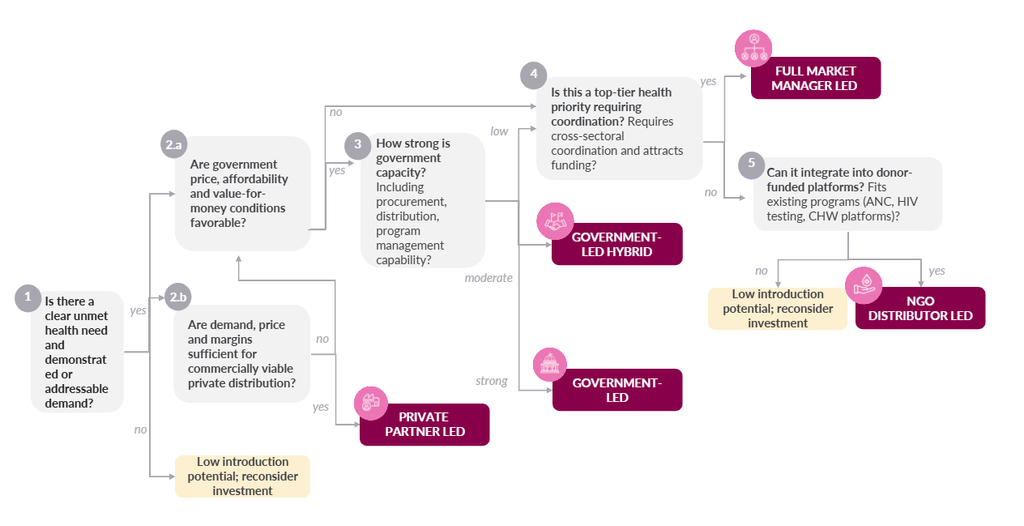
Increasingly, a mix of models – often staged to generate the evidence or volume needed to make another model succeed – may lead to the greatest effectiveness and efficiency. Two staged paths show how this can work. A product can launch in private channels at a higher margin to build demand and real-world data, then use that evidence to make the case for government procurement. Or it can pair a private partner with an NGO distributor, test both routes and back whichever gains traction.
Sometimes the answer is: don’t launch. It is easy to assume that economics will improve with R&D and launch volume. Some do, but the safer course is to design for demand that exists today, and to set stage-gates on cost of goods and margin that a product must pass before it unlocks the next tranche of funding. A product with thin margins, no government appetite, and no donor willing to coordinate it does not turn viable because the funding model around it changed. That is the shift’s hard edge. Products that could once count on years of donor funding must now wait for a real commercial or government pathway. Launch without one, and donor cash may carry the product for a while. When that cash dries up, the product will collapse with it.
What this means in practice
Across a product’s lifecycle, there are important considerations at play:
- Upstream, in product design and R&D: manufacturers and donors should prioritize products whose value proposition can compete for government budget or sustain commercial margins on its own, not just ones that are scientifically promising. Testing the value proposition and the pricing and margins throughout R&D – starting early – and taking honest calls on whether to move forward is also critical.
- At introduction in picking and staging the mix of go-to-market models: plan the sequence before launch, and choose the mix that gets the product to real-world data and sustainability fastest. Start with private partner-led where margins exist, government-led where capacity is strong, and hybrid where a partner can fill a real gap, then use each stage’s evidence to move left along the spectrum. Reserve NGO distributor and market manager models for products that genuinely need donor coordination and support.
- At rollout, as programs scale: NGOs and implementing partners should treat bridge funding as a transition tool toward government or private ownership, not a permanent arrangement.
The donor-funded era will not end overnight, but it is no longer the default to plan around. At the same time, new pockets of funding are emerging, particularly around AI and technology, with technology companies, philanthropic foundations and investors increasingly financing AI-enabled health innovation. For example, Coefficient Giving increased its 2026 commitment to evidence-based global health and development programs from USD 175 million to USD 1 billion. Similarly, Anthropic and the Gates Foundation recently announced a USD 200 million partnership to advance AI applications across global health, life sciences and other development sectors, while OpenAI and the Gates Foundation committed USD 50 million to support AI-enabled primary healthcare across Africa. These investments could create opportunities to rethink how health products are introduced and scaled, from accelerating R&D and improving demand forecasting to reducing distribution costs and strengthening last-mile delivery.
The five launch and scale models will need to adapt to this evolving landscape, with funders, manufacturers, governments and implementing partners exploring new financing partnerships and technology-enabled approaches. Yet AI funding alone will not solve the challenge of financing product procurement and sustained access. The fundamental question remains: is there a viable commercial or government pathway once donor funding ends? This question must be answered early, during R&D, rather than after a product has been developed and resources committed.
At Dalberg, we work with funders, manufacturers and governments at every stage, from R&D to scale, helping them navigate this changing landscape and ensure life-saving products continue reaching patients as traditional funding models evolve.
- Dalberg analysis based on announced cuts as of 2025 and OECD (2025). ↩︎
ERIN BARRINGER
Partner, Dalberg Advisors
LILLIAN KIDANE
Partner and Regional Director for Africa, Dalberg Advisors