




Dalberg uses cookies and related technologies to improve the way the site functions. A cookie is a text file that is stored on your device. We use these text files for functionality such as to analyze our traffic or to personalize content. You can easily control how we use cookies on your device by adjusting the settings below, and you may also change those settings at any time by visiting our privacy policy page.
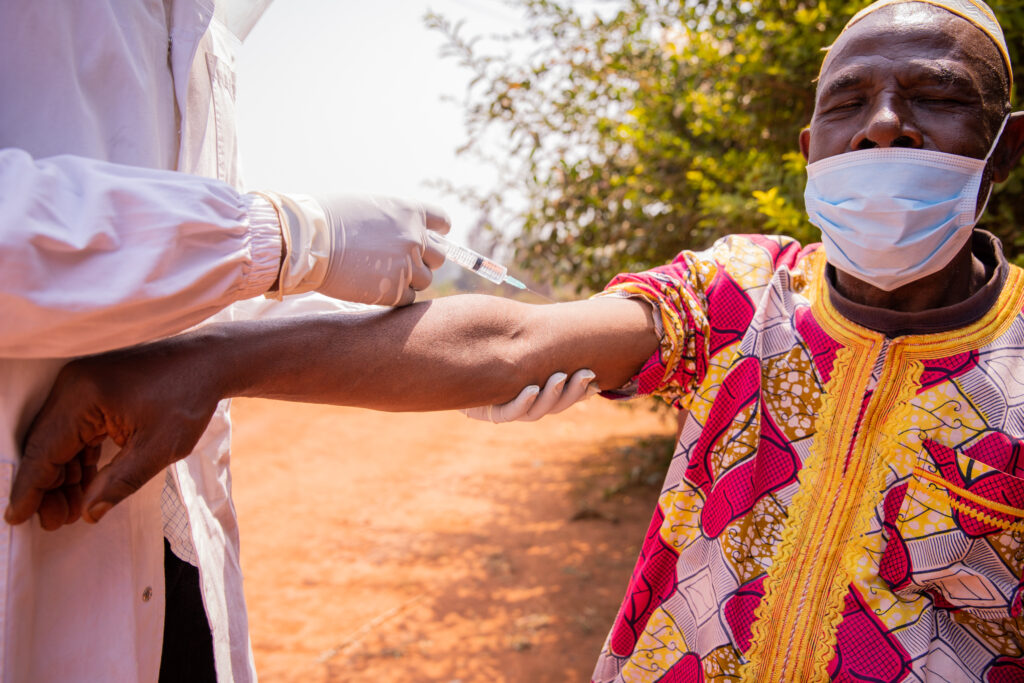
Global health preparedness works well for threats that have already killed thousands. It fails consistently for threats that are rare but recurring. The 2026 Bundibugyo virus outbreak shows what that failure costs. It also shows what to do differently.
When health workers in Bunia, northeastern DRC, began reporting unusual fevers in late April 2026, it took four weeks to confirm the cause: Bundibugyo virus, a species of Ebola for which no approved vaccine or treatment exists. By then, cases had spread across three provinces and crossed into Uganda’s capital, Kampala. On May 16, the WHO declared a Public Health Emergency of International Concern.
The Bundibugyo virus has caused outbreaks before in Uganda in 2007 and DRC in 2012. It is enzootic to the Congo basin, with bats as the suspected reservoir. Spillover risk continues to rise as deforestation, wildlife trade, and bushmeat hunting intensify contact between humans and animal reservoirs in the region. While these drivers could be reduced through land-use reform and wildlife trade restrictions, they show no signs of diminishing, resulting in recurring spillover events. Given these conditions, the 2026 outbreak was foreseeable. Yet, in May 2026, the world had no approved vaccines or therapeutics, no pre-written trial protocols, and a manufacturing timeline stretching to nine months.
So why was a known, enzootic, human-pathogenic virus treated as a low-priority investment for 14 years? And what would it take to prevent the same outcome for the species that comes next?
Not all Ebolaviruses are equal.
There are six known Orthoebolaviruses, of which four cause human disease. A critical distinction other than human vs. animal is the intersection of human pathogenicity and historical outbreak burden that determines the order of priorities when it comes to preparedness countermeasures.
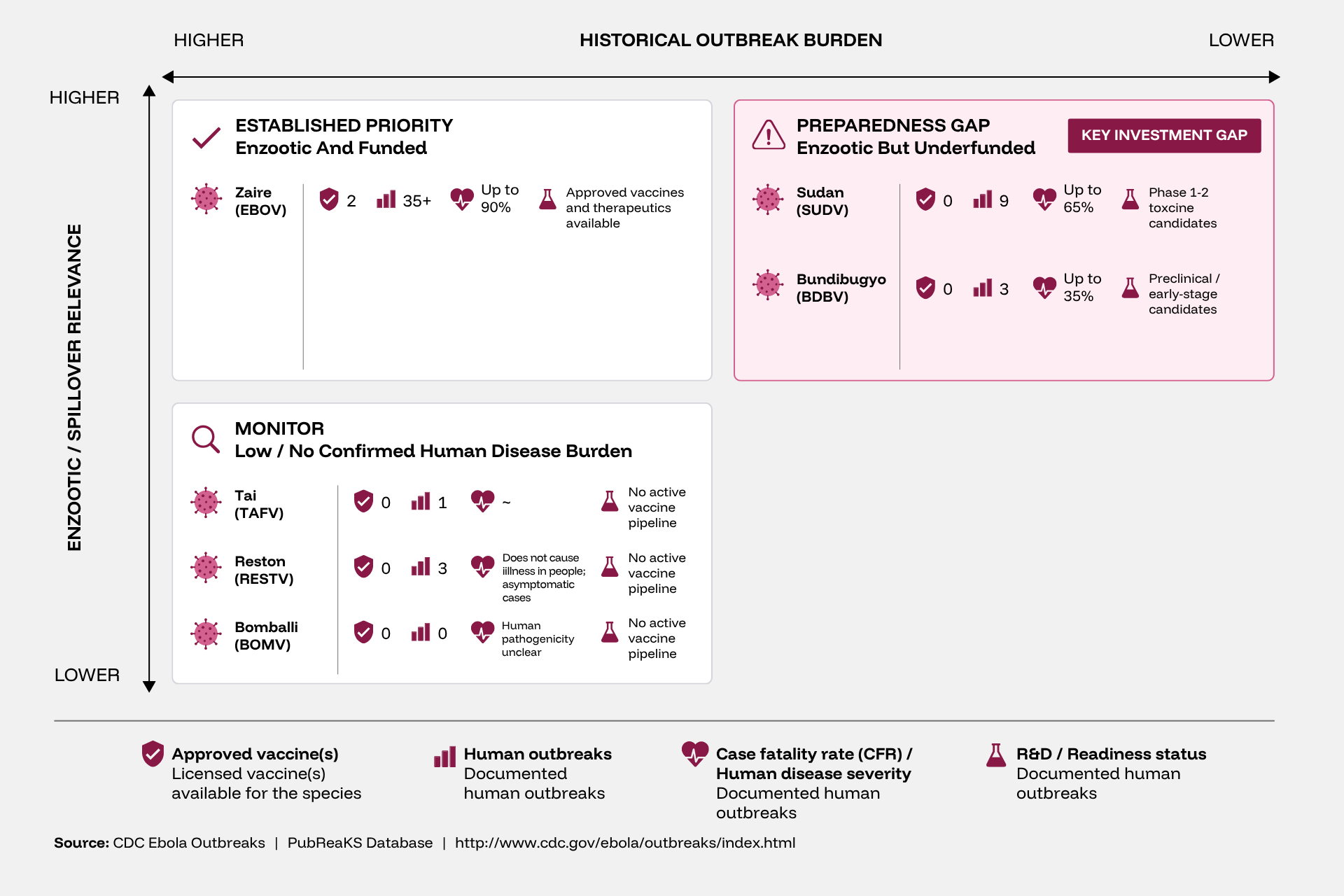
The upper-right quadrant is the gap. The Sudan and Bundibugyo viruses are both enzootic to the same DRC/Uganda border as the Ebola virus (species Orthoebolavirus zairense). Both cause recurring human outbreaks, and both have zero approved countermeasures, as of June 2026.
The Sudan and Bundibugyo viruses are predictable risks. The DRC-Uganda border has the ecological and social conditions that enable spillover: deforestation, wildlife trade, and cross-border movement, and conflict will continue to create contact between humans and animal reservoirs. Containment, once it occurs, is hard.
Prevention, including habitat protection, wildlife trade regulation, and livelihood alternatives, is a key part of the solution. This document focuses on preparedness infrastructure, but not because preparedness takes precedence over prevention. While both are critical and must advance, preparedness cannot wait for preventive measures to be put into practice.
Outbreak size tends to drive funding decisions.
The investment pattern across Orthoebolaviruses species shows that global attention has followed the size and visibility of outbreaks, not the absence of outbreak-ready countermeasures.
The Ebola virus became the global priority after the 2014–16 West Africa epidemic, which saw more than 28,000 cases, 11,000 deaths, and international transmission. That shock triggered the full suite of preparedness countermeasures investments: vaccine development, manufacturing support, advance purchase commitments, stockpiles, and therapeutics. As a result, Orthoebolavirus Zairense is now the only Ebola species with approved vaccines, approved treatments, and deployable countermeasures at scale.
The Sudan virus followed a different trajectory. It attracted renewed attention after Uganda’s 2022 outbreak exposed an immediate readiness gap: there was no approved vaccine for a known, human-pathogenic Ebola species. Since then, investment has accelerated, including support for clinical development, research tools, and outbreak trial readiness. But that funding came only after the gap became visible during an outbreak.
The Bundibugyo virus shows a deeper failure. Despite outbreaks in Uganda in 2007 and DRC in 2012, it received no comparable species-specific preparedness investment during the 14-year silent period. When the Bundibugyo virus re-emerged, there were no approved vaccines, no pre-positioned doses, and no standing trial architecture ready to activate.
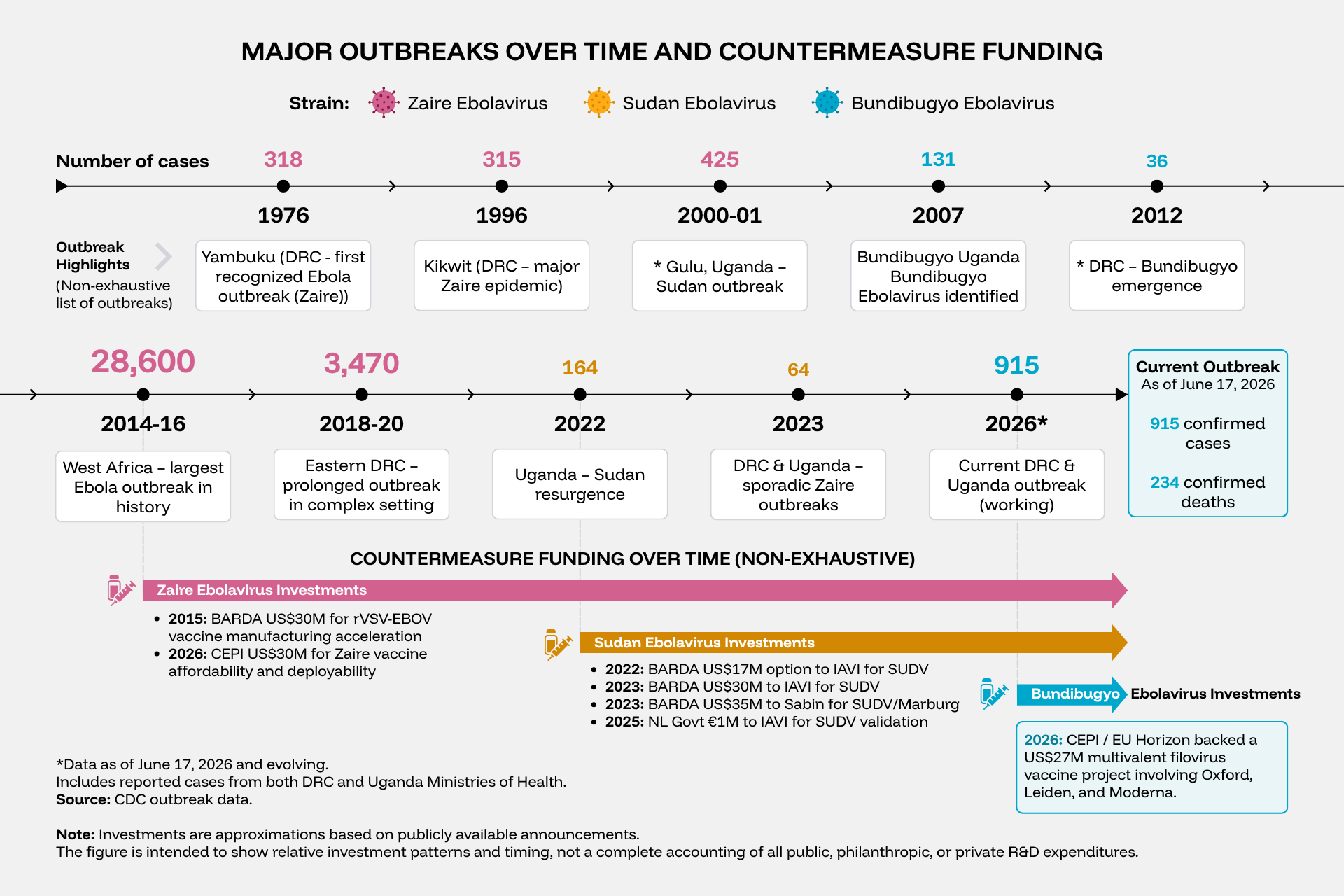
[Illustrative, based on publicly available funding announcements; not a comprehensive financial audit]
The figure above uses indicative relative investment levels based on publicly available funding announcements from CEPI, NIH/NIAID, BARDA, and others. It illustrates the structural pattern: investment has tracked outbreak magnitude and political visibility more closely than countermeasure readiness gaps. The Ebola virus (species Orthoebolavirus zairense)-focused investments dominate after the 2014–6 West Africa epidemic, the Sudan virus-focused investments appear only recently after the 2022 Uganda outbreak exposed the absence of an approved vaccine, and the Bundibugyo virus remains largely absent from species-specific countermeasure funding.
There are understandable reasons why financing has been concentrated on the Ebola virus (species Orthoebolavirus zairense): it caused the largest outbreaks, had the clearest near-term demand case, and benefited from faster product development pathways once global attention converged. But that logic is incomplete for enzootic-but-rare species, where the relevant question is not whether each species can justify a comparable investment case, but whether a modest, sustained readiness investment could prevent a predictable outbreak from becoming a regional emergency. A stronger investment decision-making framework would weigh spillover probability, the expected cost of delayed response, and countermeasure readiness gaps before an outbreak is declared. This analysis should then be used to allocate preparedness funding where and when it is most needed.
The January 2026 CEPI and EU Horizon Europe commitment points in the right direction. The program offers funding up to USD 27 million for Oxford, Leipzig University, and Moderna to develop multivalent vaccine candidates against multiple filoviruses, including the Ebola, Sudan, Bundibugyo, and Marburg viruses. This reflects the shift preparedness financing needs to make from single-species, post-crisis investment toward platform-based, portfolio readiness for known and emerging filovirus threats.
The pipeline exists. The problem is where it sits.
The most important lesson from the product landscape is that promising science has not been converted into outbreak-ready assets. The encouraging finding from the current product landscape is that science is not starting from zero. For both the Sudan and Bundibugyo viruses, vaccine and treatment candidates exist. Rather than the absence of scientific direction, the problem is the distance between promising candidates and outbreak-ready countermeasures.
That distance varies sharply by species. The Sudan virus pipeline is meaningfully further along: it has two vaccine candidates in clinical development, including IAVI’s rVSV-SUDV candidate and Sabin’s cAd3-SUDV candidate, as well as investigational therapeutic options with human safety or compassionate-use history.
Bundibugyo virus vaccines face an inherent challenge: without ongoing transmission, clinical trials are not possible. The pipeline reflects this reality. Three vaccine candidates are now receiving funding, each at a different stage of readiness:
- rVSV platform (IAVI): The same technology behind Merck’s approved Ebola virus vaccine, adapted for Bundibugyo. It has shown survival benefit in non-human primates, but no doses are currently available for clinical trials, and WHO has indicated manufacturing could take six to nine months.
- ChAdOx platform (Oxford/Serum Institute of India): Familiar from the Oxford/AstraZeneca COVID-19 vaccine. Production is underway and doses could be ready in two to three months, but animal studies have not yet been completed and there is no human data for its use against Bundibugyo.
- mRNA-LNP platform (Moderna): The earliest-stage of the three. Preclinical data remains limited, no clinical-grade material currently exists, and manufacturing has not yet begun. Its principal advantage is speed and scalability: the genetic instructions can be swapped to target Bundibugyo while reusing established design and manufacturing processes.
Better preparedness measures such as pre-negotiated clinical protocols, established regulatory pathways, and manufacturing capacity might compress the gap between outbreak detection and trial initiation. But clinical validation will still depend on cases occurring.
Therapeutics face a similar challenge. Several options are being assessed: pan-Ebolavirus antibodies such as MBP134, Regeneron’s Maftivimab-related approach, and survivor-derived antibodies such as BDBV289-N, and antivirals including Remdesivir and Obeldesivir. But most of these rely on early-stage, laboratory, animal, or compassionate-use evidence rather than approved, Bundibugyo-specific clinical data.
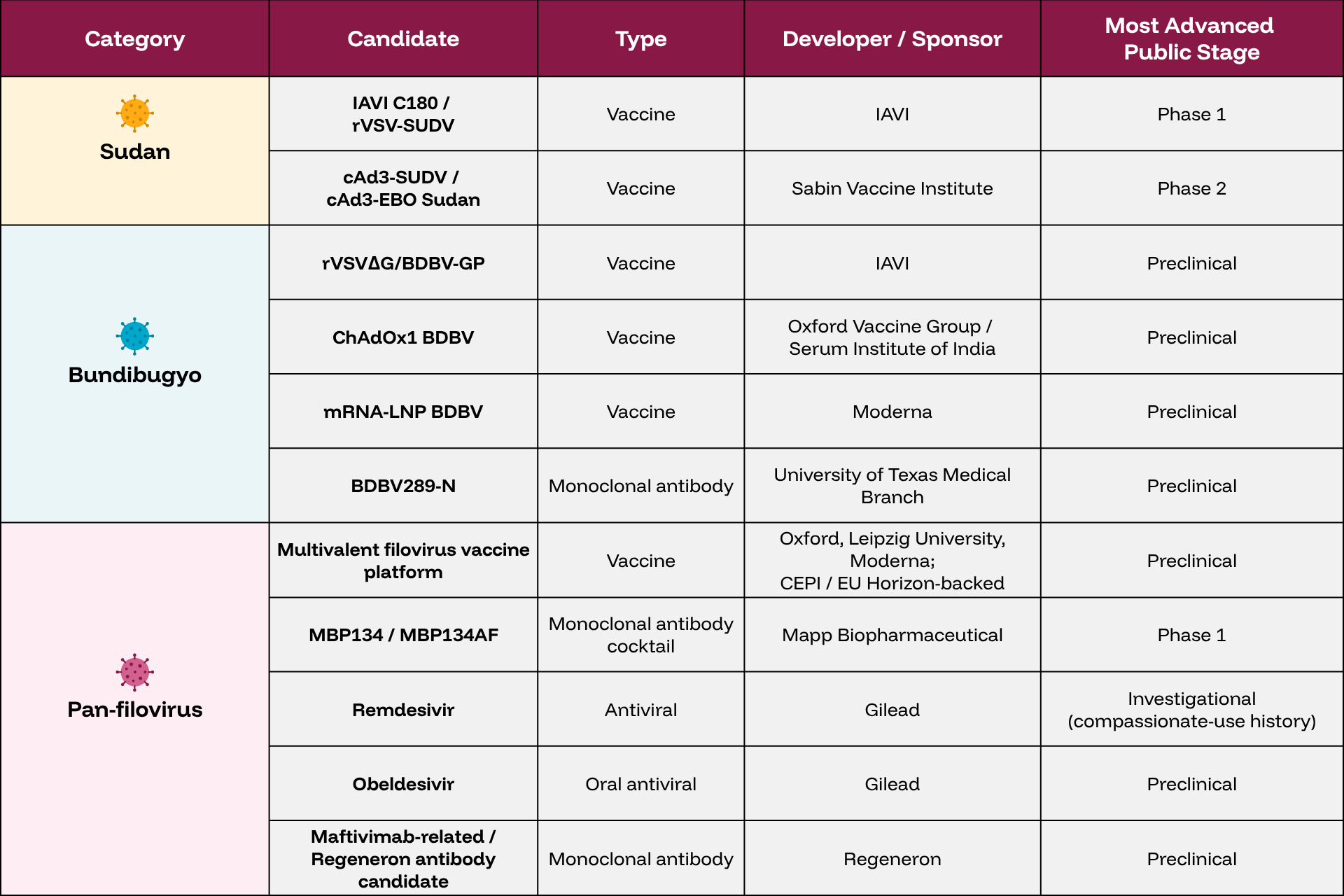
The contrast matters because readiness is operational, not theoretical. IAVI’s Sudan virus ring vaccination trial (TOKEMEZA SVD) launched just four days after Uganda’s January 2025 outbreak declaration because the protocol was prepared and doses were available. That is what preparedness looks like. The Bundibugyo virus had no equivalent when it re-emerged in 2026. The science existed, but the system had not moved it far enough along to be useful when the outbreak began.
The 2026 Bundibugyo virus response exposed the difference between scientific progress and operational readiness. There was an absence of pre-written protocols, trained trial teams, regulatory pathways, and manufacturing capacity that can be activated immediately. A pipeline only becomes preparedness when candidates are advanced into clinical development, manufactured into deployable doses, linked to approved protocols, and ready to move within days, not months.
A call to funders: Change the logic, not just funding.
For funders, the real question is about the financing architecture that can keep countries, manufacturers, regulators, researchers, and response teams ready between outbreaks. That question requires a clearer decision logic than global health preparedness has typically applied to enzootic-but-rare threats, one that names spillover probability, expected cost of delayed response, and the portfolio value of multi-species readiness, rather than letting only outbreak magnitude drive investment priority.
Five shifts in preparedness logic are needed:
1. Treat Orthoebolaviruses as a portfolio
Currently: Ebola is often treated as a single threat category. Investment follows the scale of the last outbreak: the 2014 Ebola virus outbreak (species Orthoebolavirus zairense) caused more than 28,000 cases and triggered a massive global response. The Sudan virus belongs to the same viral family, emerges in similar ecological corridors, and poses comparable spillover risks. Yet the 2022 outbreak, with 164 cases, generated a limited response. Bundibugyo, despite belonging to the same family and geography, received virtually no countermeasures preparedness investment between 2012 and the May 2026 outbreak.
Instead: Treat members of the genus Orthoebolavirus within the Filoviridae family as a portfolio, not isolated threats. Adopt a platform approach by investing in vaccine technologies to be adaptable across all three species. This reduces per-pathogen R&D costs, allows one manufacturing footprint to serve multiple threats, and enables a single set of regulatory protocols rather than three separate pathways. CEPI 3.0 already reflects this shift, organizing work around viral families rather than individual pathogens, a framework that enables preparedness across the full genus and beyond.
2. Fund countermeasure readiness between outbreaks
Currently: Funding surges once outbreaks are declared. The Sudan virus received approximately USD 47 million from BARDA following the 2022 outbreak2. The Bundibugyo virus received essentially no dedicated investment before the 2026 outbreak. During the 14-year gap between outbreaks (2012–2026), countermeasures preparedness funding effectively disappeared.
Instead: Fund countermeasure readiness between outbreaks and not just when cases are declared. That requires a different investment logic: one that weighs the cost of maintaining readiness against the probability-adjusted cost of outbreak and pandemic mitigation. The current model rarely makes that comparison in a disciplined way, funding surges after spillover, while the investments needed to preserve readiness between outbreaks go unassessed. A stronger investment decision-making framework would systematically weigh readiness costs against probability-adjusted outbreak risk: likelihood of spillover, likelihood of geographic spread, and the cost of delayed countermeasure availability.
3. Redefine countermeasure preparedness metrics
Currently: Preparedness is often measured by the number of vaccine candidates in clinical development. By that metric, the Sudan virus appears more advanced than the Bundibugyo virus. The Sudan virus has candidates in Phase 1 and Phase 2 trials, while the Bundibugyo virus has no vaccine candidate in Phase 1 clinical trials. But candidate count alone does not tell us whether a response can move at outbreak speed. Sabin has a Sudan Ebolavirus vaccine in Phase 2, and IAVI’s Sudan virus vaccine candidate was available for a WHO-led ring vaccination trial in Uganda, but neither species has an approved vaccine.
Instead: Assess countermeasure preparedness by operational metrics: days to first trial-dose availability, speed of trial activation, and existence of pre-approved protocols and trained clinical teams. Under that framework, the Ebola virus is the only fully prepared species. The Sudan virus countermeasures are not ‘prepared’, but are further along: investigational doses had been pre-positioned, and trial protocols can be activated quickly. The Bundibugyo virus had no equivalent. These indicators are rarely tracked or funded between outbreaks, which is precisely why they are missing when outbreaks begin.
4. Clarify who funds countermeasure preparedness infrastructure
Currently: Vaccine R&D has clear institutional owners: CEPI, NIH, and BARDA. But manufacturing maintenance, trial readiness, and clinical preparedness often fall into institutional gaps and are funded inconsistently, if at all.
Instead: Assign clear responsibility for filovirus preparedness infrastructure. Whether the funding mechanism sits within WHO, CEPI, BARDA, or a dedicated multi-donor trust fund matters less than the principle itself. Someone must be responsible for financing manufacturing readiness, pre-positioned trial infrastructure, and clinical workforce training for enzootic-but-rare species on a rolling multi-year basis. This responsibility should not rest only with global R&D institutions. It should be co-owned with affected and at-risk countries, Africa CDC, regional economic communities, and national public health institutes, so that financing decisions reflect the realities of surveillance, trial activation, workforce readiness, and deployment in the places where outbreaks begin.
5. Fund preparedness infrastructure where spillover occurs
Currently: Countermeasure development, manufacturing, and trial design happen in high-income countries. Preparedness is built elsewhere and deployed after spillover. This creates delays, misalignment with local systems, and extractive research partnerships.
Instead: Build standing manufacturing capacity, trial infrastructure, and clinical teams in the DRC-Uganda border. The most effective model is modular and multi-pathogen: filovirus-ready manufacturing, trial, regulatory, and community systems integrated within broader outbreak preparedness, rather than stood up as a parallel structure. That integration also guards against a recurring failure: preparedness designed in distant capitals that arrives too late and fits too poorly. This matters most where trust is the constraint. In the DRC-Uganda border, decades of research extraction, vaccine hesitancy, and mistrust of health authorities mean that speed without legitimacy produces failure. Trial protocols parachuted in during outbreaks will activate too slowly because they arrive as external impositions, not local solutions. The alternative is to build trial infrastructure and train clinical teams between outbreaks, in partnership with community leaders and health workers, so that when spillover occurs, the system is already embedded, already trusted, and can move at outbreak speed. That requires local ownership, with international support subordinate to local priorities and decision-making.
It is essential that preparedness infrastructure survives between outbreaks. It survives when it is institutionalized into local organizations and ecosystems. Local leadership must remain responsible and accountable for maintaining a consistent planning cadence, ensuring mainstreaming of related activities into local budgets, proactively building community trust, and ensuring that systems outlast the current crisis and are ready to meet the inevitable next outbreak.
The window is now.
The 2026 Bundibugyo virus outbreak will likely be contained. Will it change the preparedness logic that left the world exposed in the first place? If funders wait for the next spike in cases before investing, the next enzootic Orthoebola virus outbreak will produce the same scramble, delays, and preventable gaps. The same logic applies well beyond Ebola: Marburg and other high-risk regional pathogens follow the same predictable pattern of neglect between outbreaks, and a financing system that only responds to the threat currently making noise will keep being caught flat-footed by the ones that aren’t. If funders act now, the Bundibugyo virus can become the inflection point when countermeasure preparedness financing finally catches up with predictable risk, not just for Ebola, but as a framework for assessing and funding against the full landscape of known, recurring threats.
- Sources: IAVI, ‘IAVI starts first-in-human Phase 1 clinical trial of single-dose Sudan virus vaccine candidate, June 27, 2023; Sabin Vaccine Institute; Reuters, ‘What Bundibugyo Ebola vaccines and treatments are under development, May 21, 2026; Gilead, ‘Gilead Donates Remdesivir for Ebola Clinical Trial in the Democratic Republic of the Congo’, October 8, 2025; GAVI, ‘New study suggests Ebola could be cured with a pill’, March 20, 2025. ↩︎
- Account for SUDV exclusive investments (not combined with Marburg). ↩︎

LILLIAN KIDANE
Partner and Regional Director for Africa, Dalberg Advisors