




Dalberg uses cookies and related technologies to improve the way the site functions. A cookie is a text file that is stored on your device. We use these text files for functionality such as to analyze our traffic or to personalize content. You can easily control how we use cookies on your device by adjusting the settings below, and you may also change those settings at any time by visiting our privacy policy page.
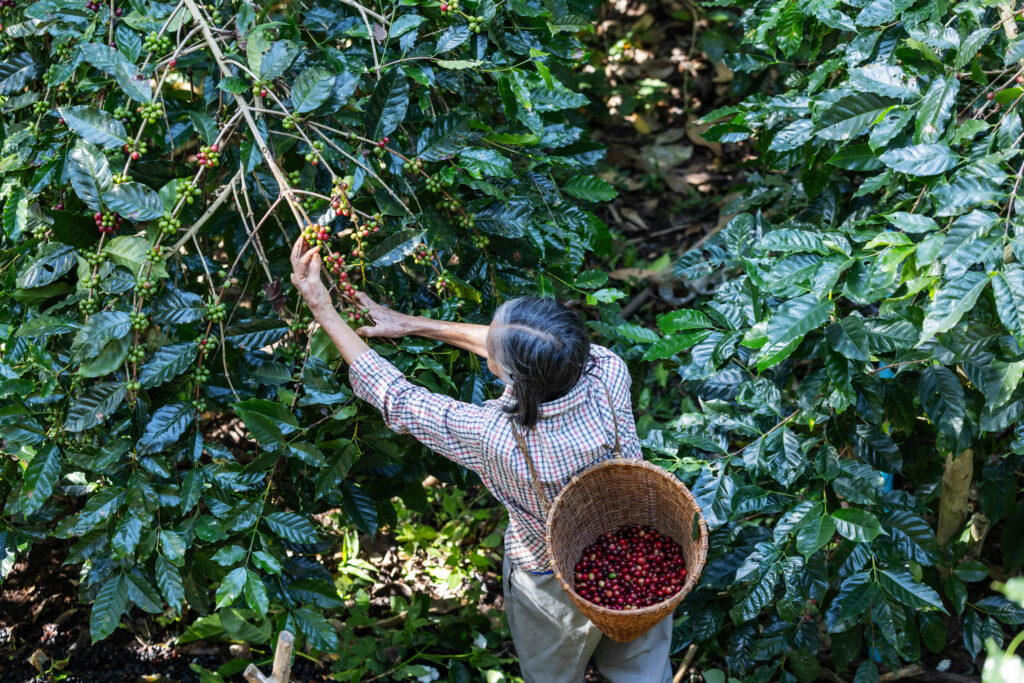
Most sustainability strategies in agriculture are, in fact, solving the wrong problem. Global food companies have spent decades investing heavily in yield improvement, certification programs, input distribution, and farmer training. Yet the underlying economics have barely shifted. Farming is often not economically viable. When farmers cannot earn a stable and sufficient income, they do not invest in their land, they stop producing, and supply chains become more fragile over time. Far from being a peripheral issue, this is a core business risk. Over the next decade, global agricultural productivity is projected to grow slower than in previous decades, at just 1.1% annually, while climate shocks, market volatility, and demographic shifts intensify pressure on farming systems. The future of long-term supply security depends not only on how food is grown, but on whether farmers can afford to continue.
Procurement models predominantly concentrate supply chain risk on those least able to absorb it: farmers. Among the most vulnerable are smallholder farmers, who produce roughly one-third of the world’s food. In India’s mint-growing regions, smallholders who produce the world’s only commercial source of menthol often face the impossible choice of feeding their families today or replanting for the next season. West African farmers grow 57% of the world’s cocoa and live in poverty. Similarly, in coffee, vanilla, and tea—crops that define the identity of global brands—the farmers at the base of the supply chain are frequently the least protected from the price swings and climate shocks that those brands can otherwise absorb.
The economics of agricultural systems have not changed, despite growing investment in sustainability and certified sourcing programs. The incentives that determine whether a farmer plants, invests, or walks away from the land remain largely untouched, and trying to influence farmer behavior without changing those incentives is futile. For companies, the costs accumulate quietly: higher prices when low yields force last-minute spot market sourcing; quality failures that increase waste and rework; the recurring expense of finding and onboarding new suppliers when farmers exit key crops; and lost revenue when supply gaps mean products simply do not reach the shelf. It’s a mistake to think these are sustainability costs. They are P&L costs, and they compound as supply systems grow more fragile.
Redefining the corporate-farmer relationship
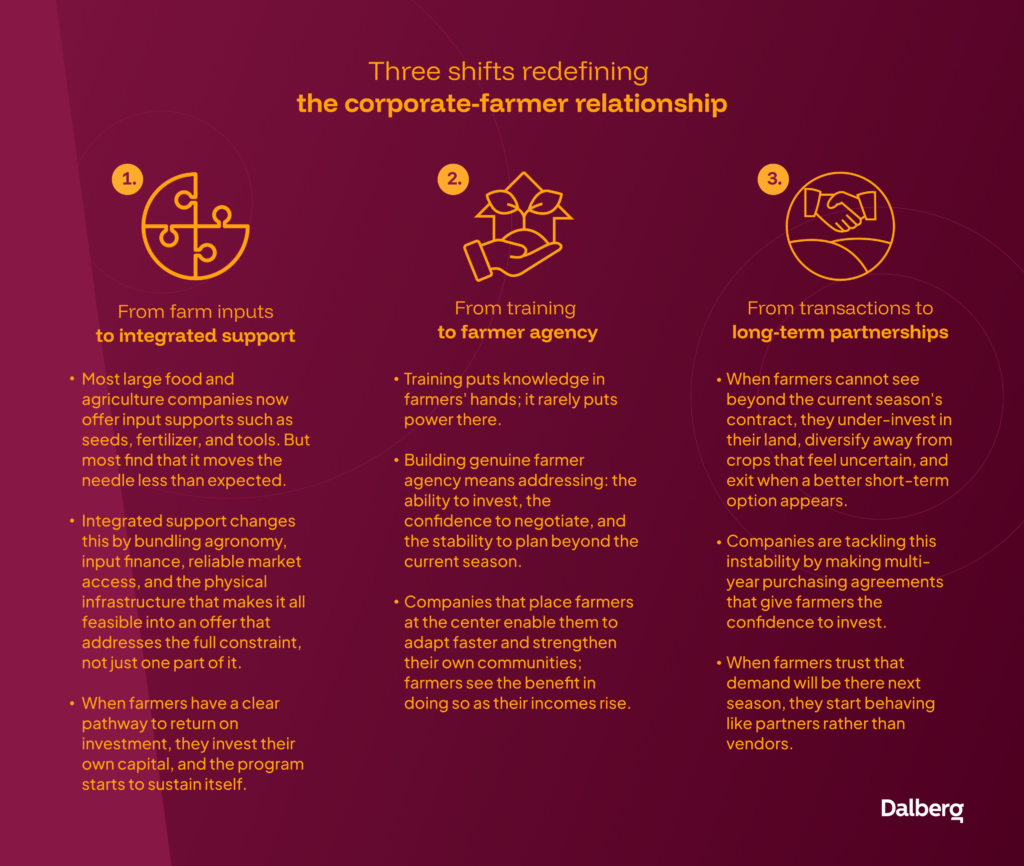
The economic case can no longer be ignored. Companies that have moved beyond input provision to actively supporting farmer income are seeing returns in the metrics that matter: ingredient quality, volume reliability, and the kind of supplier loyalty that doesn’t evaporate when a competitor offers a marginally better contract. Three shifts define how the most advanced companies are making this work:
1. From farm inputs to integrated support
Providing seeds, fertilizer, or tools has become standard practice. Most large food and agriculture companies now offer some form of input support, and most find that it moves the needle less than expected. Inputs only work when farmers can afford to use them properly, have the agronomic knowledge to deploy them effectively, and have a reliable market to sell into when the harvest comes. Integrated support changes this by bundling agronomy, input finance, reliable market access, and the physical infrastructure that makes it all feasible into a coherent offer that addresses the full constraint, not just one part of it.
This matters for company economics too: when farmers have a clear pathway to return on investment, they invest their own capital, and the program starts to sustain itself. Nespresso’s AAA Sustainable Quality Plan combines farmer incentives with hands-on technical support to deliver superior coffee quality that positions Nespresso as a premium brand with consumers. Hundreds of agronomists partner directly with farmers to develop new ways to improve soil health and embed climate-resilient practices. The company also works closely with farmer associations to expand access to complementary mechanisms like credit and subsidies that lower farmers’ barriers to invest. Coupled with Nespresso’s quality-based coffee premiums, farm improvements translate into higher, more reliable income for farmers.
2. From training to farmer agency
Training puts knowledge in farmers’ hands. It rarely puts power there. Without decision rights, financial runway, or a reliable market to sell into, a farmer who knows exactly what to do differently is still unable to do it. Building genuine farmer agency means addressing all three: the ability to invest, the confidence to negotiate, and the stability to plan beyond the current season. Companies that place farmers at the center enable them to adapt faster and strengthen their own communities; farmers see the benefit in doing so as their incomes rise. PepsiCo and Cargill’s 1,000 Farmers Endless Prosperity program in Türkiye shows what this looks like in practice. Farmers receive personalized support alongside smart digital tools (soil sensors, pest monitors, and satellite mapping) that shift decision-making towards data and evidence. Financial literacy training extends that shift beyond the field. Yields have increased by up to 20%, but the more meaningful measure is whether farmers are reinvesting, planning, and choosing to stay. The goal is reaching a stage at which farmers no longer need a program.
3. From transactions to long-term partnerships
When farmers cannot see beyond the current season’s contract, they behave accordingly. They under-invest, they diversify away from crops that feel uncertain, and they exit when a better short-term option appears. The structure of the relationship produces the instability companies are trying to fix. Increasingly, companies are changing this by making commitments that extend far enough to change farmer planning horizons. Multi-year purchasing agreements give farmers the certainty to invest in their land. Transparent pricing mechanisms—floor prices, indexed contracts, or revenue-sharing arrangements—protect farmers from the volatility that makes investment feel irrational. When farmers trust that demand will be there next season, they start behaving like partners rather than vendors.
Take the Farm to Market Alliance, a coalition including Yara and Bayer that demonstrates what this looks like at scale in East Africa. By connecting smallholder farmers to reliable market linkages through partnerships across agribusinesses, financial institutions, and development sector players, the Alliance has delivered over 100,000 metric tons of ingredients. The more significant outcome is the reduction in farmer exit from key crops — reliable demand changes the calculation farmers make about whether to stay.
Making the shift work
Companies that act on these insights can translate momentum into measurable, lasting impact. Dalberg’s experience points to five considerations for companies willing to take the next step:
- Start with the real constraint. Diagnose what limits income improvement for farmers and design around that. Root causes may include price volatility, low access to finance, labor constraints, weak market access, and high transaction costs.
- Design for shared risk and reward and embed it into ‘business as usual’. Move to contractual relationships that build value for both farmers and companies, multi-year contracts, co-investment facilities, and transparent pricing structures. Showcase successful models internally to support wholesale change in procurement practices, and integrate social outcome KPIs into performance incentives for business teams.
- Build local capacity, not dependency. Strengthen farmer organizations, aggregators, and local enterprises that can sustain gains beyond corporate program budgets or donor cycles. Work with peer companies to build more robust farming ecosystems that improve conditions for all.
- Make inclusion operational. Involve women and new farming generations in problem solving and benefit-sharing. They represent the future of farming and evidence points to these groups being more open to innovating for change. Partner with implementers that know how best to engage farmers on solution design and that can bring complementary capabilities.
- Integrate internal efforts for consistent delivery and trust. Integrate internal efforts that engage farmers in a mutually reinforcing way, from human rights risk assessment to flagship initiatives. Doing so maximizes efficiency for companies and presents an opportunity to deliver comprehensive, evidence-based strategies that meaningfully shift farmer economics.
When a cocoa farmer in West Africa reinvests in her land this season because a multi-year contract gave her the financial certainty to do so, or a mint grower in Uttar Pradesh in India decides to replant because the economics finally made sense, these are supply chain outcomes as well as social outcomes. It’s misleading to think of farmer economics as a sustainability problem that sits alongside the business. It’s a business problem that underlies all the others. Companies that treat them as such will build supply chains that last.
For more on agriculture and food systems, see here.

LAURA AMAYA
Partner and Regional Director for Europe, Dalberg Advisors