


Dalberg uses cookies and related technologies to improve the way the site functions. A cookie is a text file that is stored on your device. We use these text files for functionality such as to analyze our traffic or to personalize content. You can easily control how we use cookies on your device by adjusting the settings below, and you may also change those settings at any time by visiting our privacy policy page.

Land degradation negatively impacts food security, climate resilience, biodiversity, and the livelihoods of millions of people. To address this, the Global EverGreening Alliance (GEA) launched Restore Africa, backed by Climate Asset Management (CAM), the world’s largest community-led nature-based carbon removal program. In over 30 years, it aims to restore 1.1 million hectares across Kenya, Uganda, and Malawi and sequester 51.5 million tCO₂e through reforestation, FMNR, and climate-smart agriculture, strengthening local livelihoods and advancing UN SDGs.
GEA seeks the Gold Standard for the Global Goals certification for these initiatives. This globally respected impact standard ensures projects deliver measurable, high-integrity environmental, social, and economic outcomes. Gold Standard’s rigorous requirements assure communities, funders, and regulators that Restore Africa’s results are credible and aligned with best-in-class climate investment practices.
The Challenge: Rich Data, Fragmented Insights
As Restore Africa’s first phase rolled out, GEA and its partners collected large volumes of data from satellite imagery and carbon metrics to farmer outreach logs and gender-equity indicators. Recognizing the need and opportunity to centralize this information for faster insights, reporting, and audit, GEA partnered with Dalberg Data Insights (DDI) to create a Data Hub Toolkit. The toolkit is aimed at a unified, scalable infrastructure that would streamline reporting, enable Gold Standard certification, and deliver consistent progress tracking across countries.
Dalberg Data Insights translated GEA’s vision into a robust platform by enabling the core use-cases:
- Streamlined Administration & Onboarding: Quickly brings partners into the platform, sets clear targets, and defines outcome indicators.
- Secure & Accessible Data Contribution: Enables partners to submit quantitative and qualitative data via intuitive interfaces and APIs, with robust storage.
- Rigorous Data Verification & Quality Assurance: Applies automated checks, evidence cross-referencing, and field validation to ensure accuracy and compliance.
- Insightful Data Exploration & Analysis: Offers interactive visualizations and filtering tools for in-depth examination of indicators across regions and time.
- Efficient & Comprehensive Reporting: Produces polished, customizable reports for stakeholders and audits with minimal manual effort.
- Ad-hoc Data Insights: Offers custom, on-the-fly visualizations using a set of GenAI tools embedded in a chatbot for natural language queries that translate data into dynamic, interactive visualizations and insights.
The Solution: The Restore Africa Data Hub Toolkit
DDI designed and developed the Restore Africa Data Hub as a three-layered, end-to-end platform. User focus was maintained through a strict development cadence, whereby each update underwent automated stability and accuracy tests. It also involved bi-weekly stakeholder check-ins to ensure the interface aligned with real-world needs. The result is a simple yet robust system that resolves today’s fragmented data issues and provides a scalable, durable foundation for Restore Africa over the next 30 years. The toolkit consists of three systems.
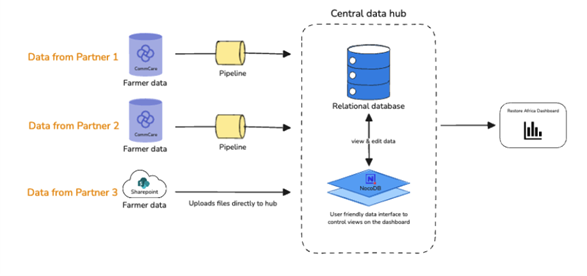
Figure 1: Systems of the Data Hub Toolkit
- Data Pipeline that automatically gets the raw data and starts the process of cleaning and checking for errors or duplicates. Calculations for metrics/indicators are done that would be needed for visualizations.
- Central Data Hub brings together the partner data of all different types into one organized warehouse. All access is governed by a permissions layer and audit logs, ensuring that only authorized users can view or modify specific datasets. A no-code interface (NocoDB) is provided for admins to browse, query, and update the settings and configurations for indicators and quality assurance algorithms.
- The secure, interactive dashboard allows end users (MEL staff, carbon specialists, project leads, or investors) to interact with real-time program metrics, trend analyses, and regional comparisons. An AI-powered chatbot handles natural-language questions (e.g., “Show me carbon progress for August 2024 in Western Uganda”) and instantly provides charts, tables, and narrative summaries. When it’s time to share findings, one click exports polished reports in PDF, PowerPoint, or Excel format, eliminating manual work and speeding up audit-ready delivery.
Already Making an Impact
The Restore Africa Data Hub has transformed GEA’s ability to manage, report, and certify Restore Africa’s impact. Centralizing data and streamlining reporting cuts time spent on manual reconciliation and ensures consistent, high-quality information for stakeholders. MEL teams now monitor restoration progress in near real-time. Carbon specialists are equipped for Gold Standard audits, and program managers produce harmonized, cross-country reports with reliable data. It empowers teams to manage complexity, scale operations, and demonstrate environmental and social progress at every stage, and funders gain clearer insight into outcomes, boosting transparency and trust.
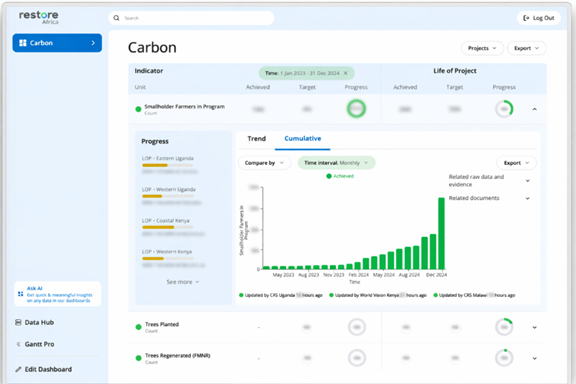
Figure 2: Interactive dashboard
A Future-proof Approach
From the outset, the Data Hub’s modular design was built to support new data types, geographic expansion, evolving certification needs, and additional programs throughout the system’s 30-year lifespan. The approach’s replicable, scalable, and extendable nature allows the partnership to expand to additional programs and allows Dalberg Data Insights to collaborate on similar solutions and other certifications.
Beyond Restore Africa, the Data Hub offers a model for large-scale, nature-based climate programs. Unifying fragmented data into a trusted source shows how digital infrastructure can scale impact, enhance transparency, and build investor confidence while staying grounded in local realities.
What’s Next?
Together with DDI, GEA is exploring an “Evidence Quality Engine” that would act as a Generative AI co-reviewer for every photograph or scan that flows into the Data Hub. Because each image is an auditable proof point linking a specific farmer, date, location, and activity, the prototype focuses on four computer-vision tests:
- Clarity & framing – Is the image sharp and contains all mandatory zones (e.g., signature box, seedling bundle, participant roster)?
- Context – Do the embedded GPS and timestamp fall inside the project boundary and the scheduled activity window?
- Content – Does the detected tree species, seedling count, or participant total match what field staff recorded in CommCare?
- Evidence Uniqueness – Has a visually identical image already been submitted for another farmer or event?
Records that fail any check surface on a real-time quality check column already implemented in the warehouse and future governance dashboard, giving MEL teams a chance to confirm or correct them within days rather than discovering problems during an annual audit.
In parallel, the team is evaluating the AI-assisted digitization of legacy paperwork, including attendance sheets, distribution lists, and baseline surveys from current projects, so that these documents can be transcribed, linked to the correct farmers, and run through the same evidence checks.
Any subsequent country rollouts are expected to capture evidence digitally from day one, plugging straight into the quality-controlled backbone without additional cleanup. If adopted, these enhancements would move Restore Africa toward a largely self-cleaning dataset, faster fraud detection, and a scalable foundation for the alliance’s next decade of restoration work.
Interested in Collaboration?
Dalberg Data Insights (DDI) is a mission-driven AI and data science organization that partners with governments, social enterprises, NGOs, and multilaterals to tackle some of the world’s most urgent development challenges. We design, develop, and scale responsible, context-aware AI and data solutions that empower institutions to make more informed, equitable, and impactful decisions.
Our work spans public health, financial inclusion, climate resilience, agriculture, and education, strongly focusing on low- and middle-income countries. We help our partners unlock the value of their data, turning it into a strategic asset, and strengthen their capacity to adopt and govern emerging technologies responsibly. Visit https://dalberg.com/what-we-do/dalberg-data-insights/ to learn more!
For collaboration, reach out to Denys Sementsov at denys.sementsov@dalberg.com

DENYS SEMENTSOV
Chief Technical Officer, Dalberg Data Insights