




Dalberg uses cookies and related technologies to improve the way the site functions. A cookie is a text file that is stored on your device. We use these text files for functionality such as to analyze our traffic or to personalize content. You can easily control how we use cookies on your device by adjusting the settings below, and you may also change those settings at any time by visiting our privacy policy page.
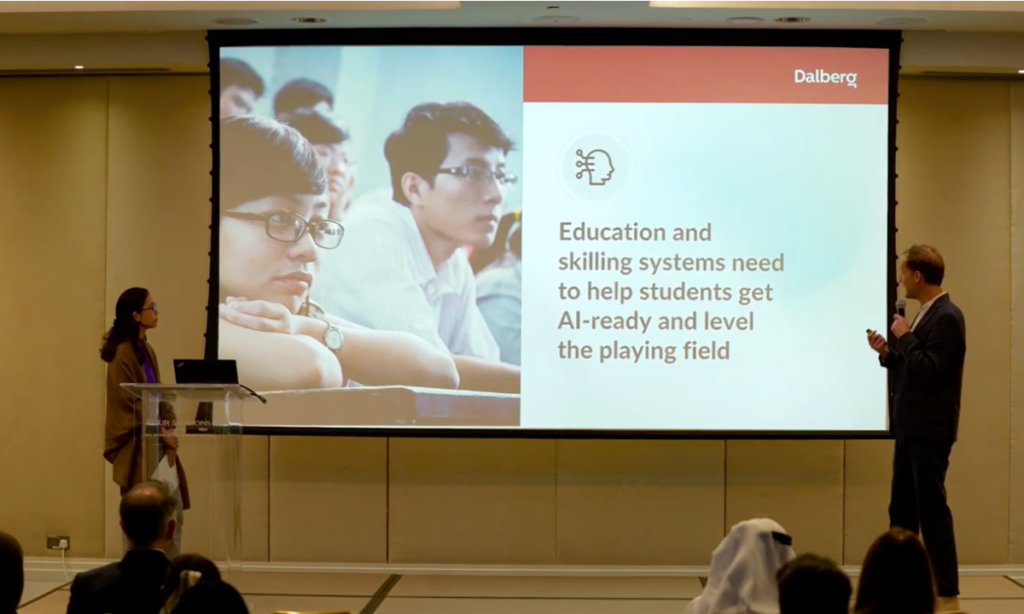
As artificial intelligence rapidly transforms workplaces and societies, the question of how to prepare future generations for this new reality is more urgent than ever. Dalberg Advisors Partner Dayoung Lee and Associate Partner Charlie Habershon explored this critical topic during the Knowledge Seminar Series, held in collaboration with the Office of Development Affairs in Abu Dhabi.
The Growing Influence of AI in Work and Life
AI is reshaping workplaces at an unprecedented pace, with predictions suggesting that by 2027, a quarter of jobs globally will be impacted. For some, AI will act as an accelerator—enhancing efficiency for roles like graphic design. For others, it will serve as a tool for critical thinking and problem-solving. However, for those in routine jobs, such as data handling, AI may replace their roles entirely.
These shifts are already disproportionately affecting disadvantaged groups. As Habershon highlights, fewer women use AI compared to men in the same jobs. Ethnic minorities and speakers of underrepresented languages face barriers due to AI’s reliance on languages for which large amounts of data are available. In low-income countries, where only one in 20 students has reliable internet access at home, the digital divide makes it difficult to access the hardware and connectivity needed to benefit from AI tools.
Education: The Key to AI Readiness
Given these challenges, how can future generations cope? According to Lee, education systems must take the lead in equipping students with the knowledge and skills to navigate an AI-driven world.

Lee identifies key foundational principles for students:
- Understanding AI’s Probabilistic Nature: While AI can generate creative outputs, it can also produce errors. Students must be equipped to critically evaluate AI’s results.
- Framing Effective Problem Statements: Students need to learn how to communicate with AI effectively to derive meaningful insights.
- Adapting to Constant Change: Open-mindedness and a willingness to stay updated with AI’s evolution are essential.
To ensure equitable learning opportunities, these lessons must be delivered during school hours, providing access to students who lack reliable internet or technology at home. Classroom discussions should include topics such as how AI can solve equity issues in areas like health and education while addressing biases inherent in AI systems. Teacher training is equally vital, empowering educators to recognize and address these biases in their own classrooms.
The Role of Philanthropy in Advancing AI Readiness
Philanthropy has a crucial role to play in supporting education systems to prepare students for an AI-driven future. One example is an innovation development program in Qatar, developed in collaboration with Digi Wise. This initiative focuses on building AI readiness and digital media literacy among lower middle-income students, setting a model for how philanthropic capital can drive meaningful change.
Building a Future-Ready Generation
AI is an era-defining technology, and its opportunities and challenges will profoundly shape the future. As Lee and Habershon emphasize, ensuring that young generations are prepared to engage with AI is critical—not just for their individual success but for advancing equity and resilience in an increasingly digital world.
Watch the video to explore these ideas:
Watch the full version of the video here.

DAYOUNG LEE
Partner, Dalberg Advisors