



Dalberg uses cookies and related technologies to improve the way the site functions. A cookie is a text file that is stored on your device. We use these text files for functionality such as to analyze our traffic or to personalize content. You can easily control how we use cookies on your device by adjusting the settings below, and you may also change those settings at any time by visiting our privacy policy page.

Last year, we shared news of the launch of ‘Maisha Makutano’, a TV drama series in Kenya that now reaches over 4.5 million viewers each week and tackles issues such as financial inclusion, gender dynamics, and livelihoods.
What is notable is not only the scale of the series, but how it was designed. Drawing on research led by Dalberg Design in collaboration with Mediae, CGAP, the Gates Foundation, and the World Bank, the series is anchored in insights from women in rural and peri-urban Kenya. Those insights shaped the characters, storylines, and narrative arcs, helping the series reflect the realities of women’s lives.
Dorothy, the progressive pharmacist and justice seeker, and Gabby, the dreamer navigating family pressures, are grounded in the lives of women we spent time with through our research, reflecting recurring patterns in how women navigate aspiration, constraint, and opportunity over time.
At the core of this approach are two simple questions: how do people’s lives evolve over time, and what shapes these trajectories? The answers are rarely straightforward. The approach we use to make sense of them is what we call pathway models, or simply pathways.
The limits of designing for moments
Much of design, across products, services, and programs, focuses on specific moments such as decisions, interactions, or points of need. Tools like personas, journey maps, and service experiences have helped extend this view across sequences of interactions, bringing more structure and empathy to how we understand people. However, these approaches are often bounded, capturing defined experiences rather than the longer-term evolution of people’s lives.
In reality, progress is rarely linear. Personal trajectories are shaped not only by immediate circumstances, but also by past experiences and future expectations, with earlier events influencing later choices and current decisions carrying implications that unfold over time.
As a result, people are never navigating a single, stable journey; they are navigating multiple trajectories that evolve over time.
Introducing pathways
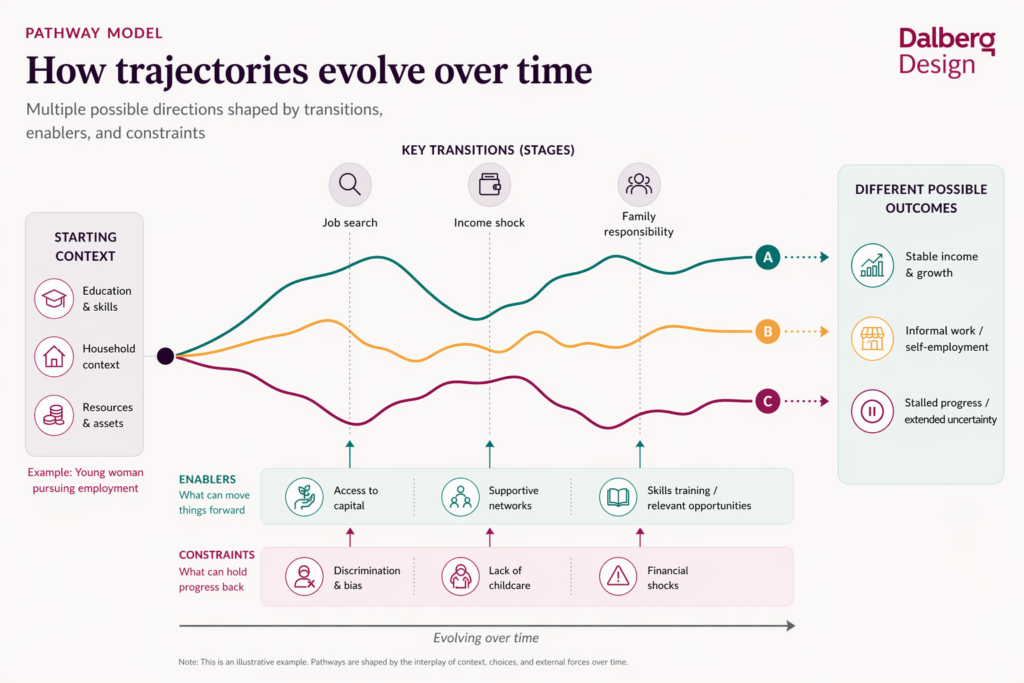
To better understand these trajectories, we use pathway models to describe how people move over time toward their aspirations. Pathways map the possible directions people take, and how those directions shift in response to surrounding conditions.
In simple terms, personas describe who people are, and journey maps describe what they experience. Pathways, by contrast, describe how their lives evolve over time.
They bring together three elements: the direction of aspiration, a set of transitions or stages, and the forces that influence movement, both enabling and constraining. This makes it possible to see not just what people do at a given moment, but how their decisions are influenced by circumstances over time to shape longer-term outcomes.
What pathways reveal in practice
Through in-depth, human-centered design research across Kenya, we were able to understand how people interpret their circumstances, respond to constraints, and adjust their aspirations as those circumstances change.
We met Lucy, a smallholder farmer in Uasin Gishu County, who has invested carefully in expanding her farm over time. Previous experiences, including being retrenched from formal employment, had shaped both her appetite for risk and the opportunities available to her. Her severance package became startup capital for new farming activities, while access to health insurance gave her greater financial stability as she experimented and adapted.
What pathways make visible is not only the route someone ultimately takes, but the alternative trajectories that may emerge under different circumstances. Without that financial cushion or healthcare support, Lucy’s trajectory may have looked very different. She may have remained focused on subsistence farming for longer, delayed investment decisions, or returned to wage employment instead.These kinds of trajectories informed not only intervention design, but also storytelling approaches like ‘Maisha Makutano‘. Characters such as Gabby and Dorothy reflect the same underlying principle: people’s ambitions, choices, and futures are shaped over time by the interaction between aspiration, opportunity, and constraint.
From pathways to design
Pathway models are not just analytical tools; they inform our design across products, services, and programs. By making visible how needs, constraints, and aspirations evolve over time, they shift design from isolated interventions toward more sequenced and adaptive approaches.
In practice, this means moving beyond bounded journeys to engaging with longer-term trajectories. Pathways help identify where people are most likely to encounter friction, stall, or change direction over time, allowing interventions to be targeted at critical moments. They also inform how support should be sequenced across stages, rather than delivered as one-off solutions, and help anticipate how needs and behaviors evolve beyond an initial interaction.
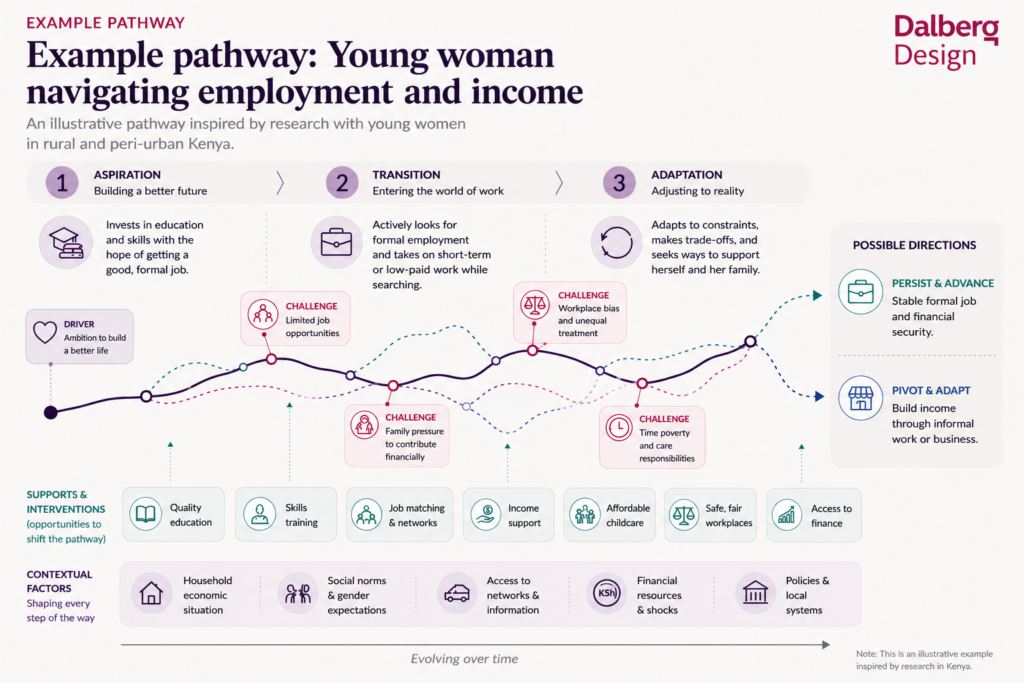
This perspective is particularly useful in complex contexts. In the Kenya research, for example, pathways showed how individuals attempting to enter formal employment often encountered structural barriers that stalled progress. This pointed not only to the need for job placement, but for a combination of support coordinated over time, including skills development, job linkage, and workplace conditions that enable retention.
Similarly, for individuals balancing income generation with care responsibilities, pathways highlighted how time constraints and lack of childcare support limited access to higher-value opportunities. This suggests different design responses, such as services that reduce care burdens or enable more flexible income pathways.
By grounding design in these longer-term trajectories, pathways help move from isolated solutions toward more coordinated systems of support.
Implications for design
Taking pathways seriously requires a shift in how we think about design.
First, pathways help us understand how circumstances evolve over time, making visible how people navigate periods of advancement, stagnation, regression, and adaptation as their lives change.
Second, by understanding how needs, mindsets, and behaviors evolve across different stages, it becomes possible to design interventions that are better timed and more responsive to changing realities.
Third, pathways help identify where support systems succeed or fail. They reveal how structural conditions, social dynamics, and external shocks influence decision-making, allowing designers to identify intervention points that account for more than individual intent alone.
Finally, pathways encourage more adaptive forms of design. Rather than assuming a single, ideal journey, they help designers work with multiple possible trajectories and design systems flexible enough to support people as circumstances shift over time.
This perspective is what enabled applications like Maisha Makutano to resonate at scale, grounding storytelling in trajectories that audiences recognize from lived experience.
As we continue to refine and apply pathway models across sectors, the challenge is not simply understanding what people do, but understanding how their lives evolve, and what it takes to support meaningful progress over time.

RAVI CHHATPAR
Partner and Co-Founder, Dalberg Design