


Dalberg uses cookies and related technologies to improve the way the site functions. A cookie is a text file that is stored on your device. We use these text files for functionality such as to analyze our traffic or to personalize content. You can easily control how we use cookies on your device by adjusting the settings below, and you may also change those settings at any time by visiting our privacy policy page.
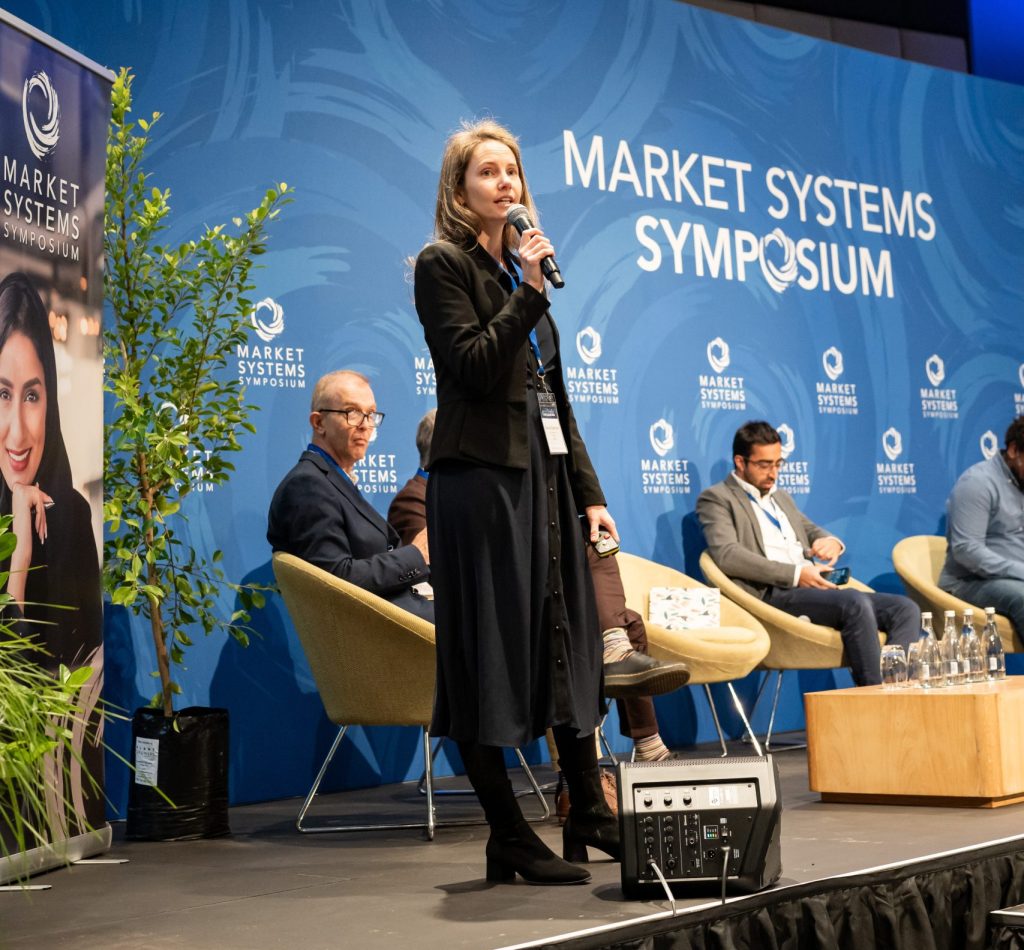
Last month, I joined the Market Systems Symposium in Cape Town, South Africa, hosted by the Vikara Institute, to reflect on the future of finance, funding and philanthropy in a world facing overlapping and increasingly interconnected shocks.
I was part of a panel alongside Tom Sanderson from the Foreign, Commonwealth & Development Office (FCDO); Reza Fazel from Open Capital; and Derek Lubner from Izinga Assist; moderated by Dumisani Nyoni from Fronteras Capital. I also shared a presentation exploring what kinds of organizations and capital models are needed to respond to challenges such as AI-driven job displacement, conflict, climate change, and widening inequality.
A central theme was the shifting role of capital in this landscape: as traditional aid contracts, philanthropy is repositioning itself as one part of a broader continuum of capital, with important implications for how resources are deployed and directed towards systems change.
Two ideas stayed with me after the symposium.
1. Solve for Now, Bridge, and Build Toward the Future
Fixing only today’s problems can slowly erode the system we are trying to protect, because new challenges go unanticipated. A more useful frame has three horizons: address the immediate challenge, use innovations or technology to bridge, and design deliberately for the future we want. This matters for program design and for what we choose to measure. As an example, for climate, you can fund ready-to-go projects now, like solar power to cut emissions and flood early-warning systems to protect communities, to deliver visible results in the short-medium term. But you need to also introduce climate budget tagging and climate risk data as an innovation to help you plan for a long-term future where budget lines are screened for climate impact, adaptation has a quantified return that private and blended capital will invest in, and the country is not dependent on project-by-project donor grants.
2. System-level Measurement is Growing, and It Starts with Understanding the System
Practitioners are increasingly looking at interconnections rather than isolated outcomes, which is an exciting shift. Once we understand the system and its maturity, we can choose the tools to track the pace of change and shifts in power dynamics. These range from AI-enabled analysis of large-scale qualitative data to traditional methods. AI can certainly make monitoring, evaluation, and learning (MEL) more efficient, but even with more data from large language models (LLMs), the hard problems remain: attributing change in a system with many actors, capturing power dynamics that rarely show up in the data, and asking whose voices feed the analysis. More data is not the same as a more representative picture.
Next Steps
I’m taking one question back into my work: how do we balance solving today’s challenges with building toward the future we want, and how do we measure progress on both?
If you’re thinking about these questions and working on new approaches to funding and systems change, let’s connect to continue the conversation.