




Dalberg uses cookies and related technologies to improve the way the site functions. A cookie is a text file that is stored on your device. We use these text files for functionality such as to analyze our traffic or to personalize content. You can easily control how we use cookies on your device by adjusting the settings below, and you may also change those settings at any time by visiting our privacy policy page.

As we come out of the UN General Assembly, UN Global Compact Leaders Summit, and Climate Week NYC, the message from boardrooms across sectors was consistent: sustainability’s next test is not the ambition of a pledge, but the rigor of the capital allocation behind it.
Companies know that sustainability matters, but many struggle to connect impact with business value. The challenge is often not the initiatives themselves, but that impact and investment are described in different languages. Sustainability leaders focus on materiality, disclosure, and risk exposure. Finance leaders ocus on cash flow, returns, and risk-adjusted value.
This disconnect leaves sustainability initiatives vulnerable. They are often deprioritized when budgets tighten and viewed as compliance costs rather than investments that generate returns.
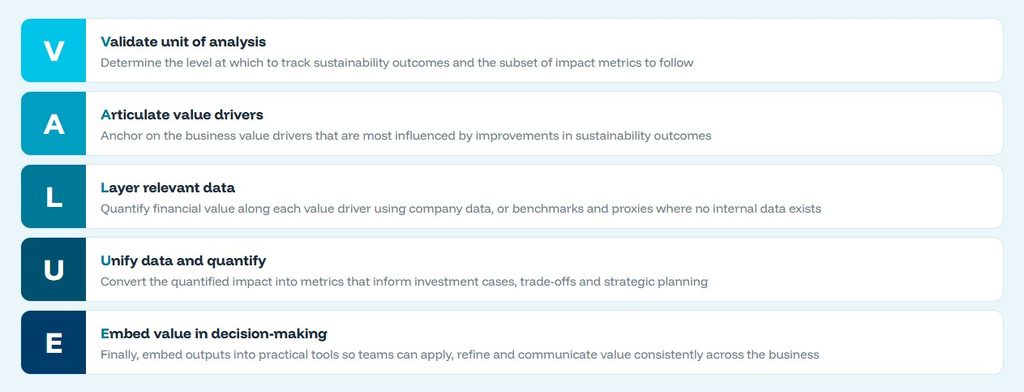
The Dalberg VALUE Framework provides a structured approach to identifying where impact creates business value and quantifying that value in financial terms. While existing frameworks tend to focus either on impact measurement and reporting or on business value quantification, the VALUE Framework bridges both. It builds on Dalberg’s experience advising companies on sustainability strategies across industries and geographies.
The Framework applies across industries, but the value drivers it surfaces are sector-specific.
Explore 4 examples below for how sustainability impact translates into business value, by industry.
Building climate resilience for smallholder potato farmers in Thailand
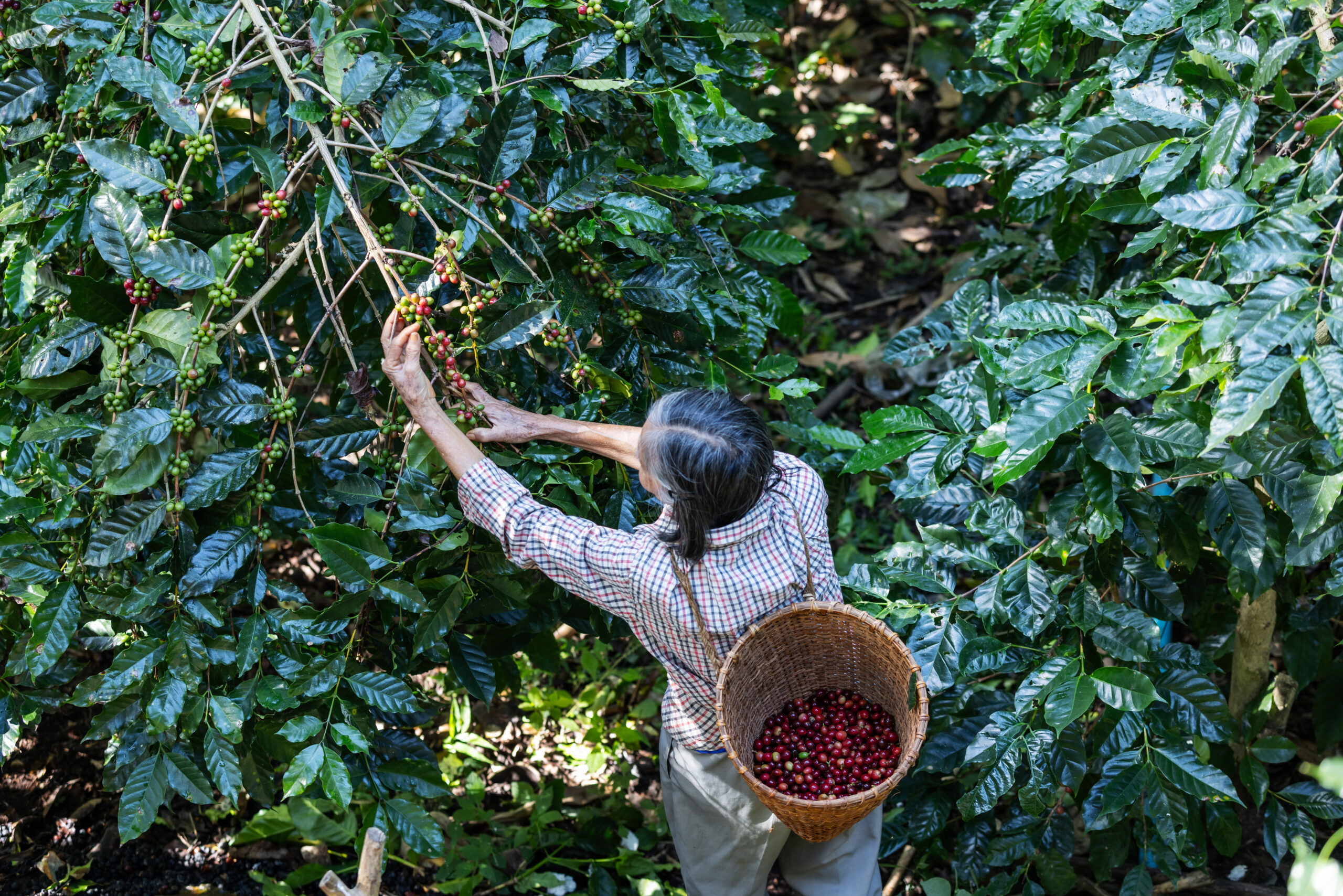
PepsiCo and partners trained 2,000+ farmers in climate-smart practices through community demonstration farms. Most farms protected yields and saw incomes increase by over 15%, while also reducing water use and on-farm emissions. Higher yields and incomes stabilized PepsiCo’s Thailand potato supply chain, retaining millions of USD in annual supply that might otherwise be lost to climate-driven yield declines or costlier imports.

Decarbonizing global cement manufacturing through alternative fuels
CEMEX reduced emissions from cement manufacturing by replacing fossil fuels with municipal, industrial, and agricultural waste. An enterprise-wide alternative fuels program had achieved a 37% fuel substitution rate by 2024, cutting Scope 1 emissions by 15% versus the 2020 baseline. For the business, this represents a lower-cost, more resilient fuel base: reduced exposure to oil price swings has been a direct financial benefit, lowering operating costs as substitution rises.

Expanding insulin manufacturing in low- and middle-income countries
Novo Nordisk is expanding insulin access by transferring technology to South Africa’s Aspen to build local production capacity and reach over 4 million patients across Africa by 2026. Building local capacity strengthens medicine availability, supports compliance with local-content requirements in public tenders, and builds distribution and regulatory infrastructure in growing diabetes markets, leveraging access initiatives to pave the way for future growth opportunities.

Lending to agriculture small- and medium-enterprises (SMEs) in Kenya
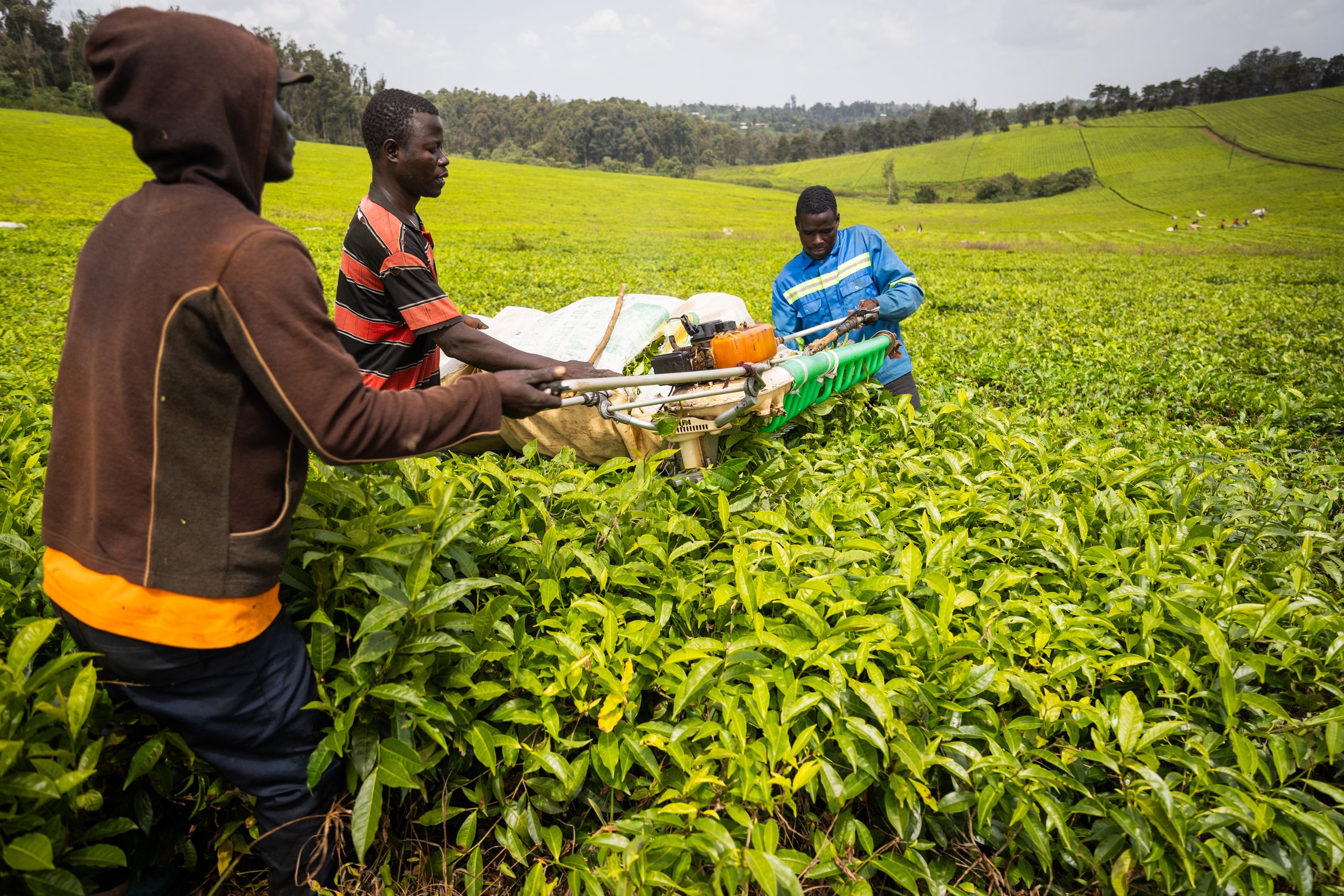
I&M Bank began lending to Kenya’s agriculture SMEs, many of which had not previously accessed loans. By lowering collateral requirements and having dedicated agri-SME teams at the branch level, the bank issued 95% of new loans to first-time borrowers, including a third to women- or youth-owned businesses. In doing so, I&M Bank found a new, fast-growing customer segment: its agriculture SME loan book grew from only 3 loans in 2023 to over 250 loans totaling $8M by 2025.
Built to be material, evidence-based, and decision-ready
Together, the five steps produce a business case that leaders across functions—Sustainability, Finance, Procurement, and Strategy—can own and act on. The VALUE Framework keeps quantification practical and decision-ready by:
- Focusing on material value: Prioritizing major cost lines, critical inputs, high-risk supply chains, and initiatives most likely to influence revenue, margins, capital expenditure, risk, or license to operate.
- Grounding analysis in evidence: Drawing on the best available internal data, industry benchmarks, market comparators, and sector-specific proxies to produce credible, context-specific insights.
- Designing for decisions: Producing outputs that help organizations prioritize initiatives, evaluate trade-offs, build investment cases, and decide what to scale, fund, redesign, or discontinue.
The result is a decision-making methodology that is both analytically robust and intuitive to use.
One framework, multiple functions
The VALUE Framework is designed for any leader responsible for approving and delivering investments. It positions Sustainability shift from reporting to value creation. It helps Finance quantify the impact of sustainability on costs, capital, and risk. It enables Procurement to build more resilient and stable supply chains. It supports Strategy teams in turning sustainability into competitive advantage by identifying opportunities for growth and differentiation that a compliance-focused approach can overlook.
See your own numbers, and get in touch to fully tailor the tool to your organization
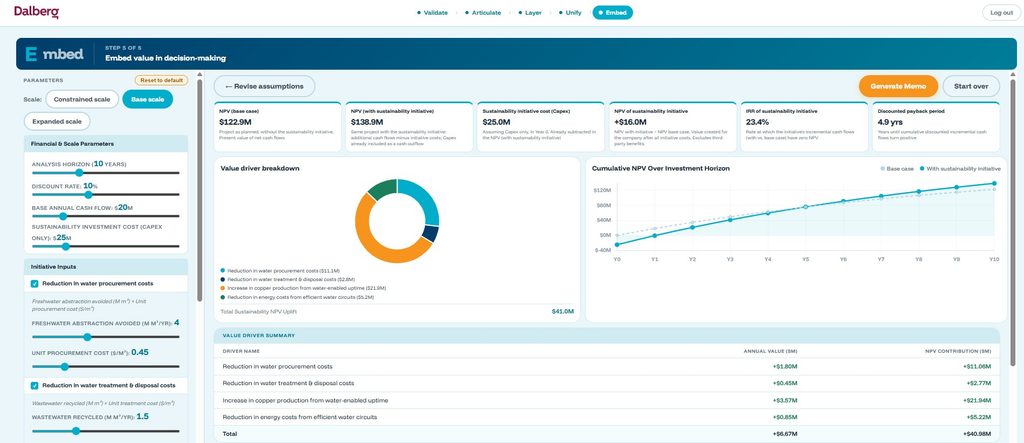
The VALUE Estimator brings the Framework to life through an interactive model. Select your sector, enter the data your company already tracks, and receive a directional estimate of the business value your sustainability initiatives could generate. Please get in touch to discuss how we can adapt the tool for your company’s sector, context and sustainability opportunities.
Disclaimer: Data inputs will not be visible to anyone at Dalberg or outside, and will not be stored internally after use.
Ready to make your sustainability strategy investable?
Connect with our Responsible Business experts to explore how the VALUE Framework can be applied to your organization.

LAURA AMAYA
Partner and Regional Director for Europe, Dalberg Advisors